
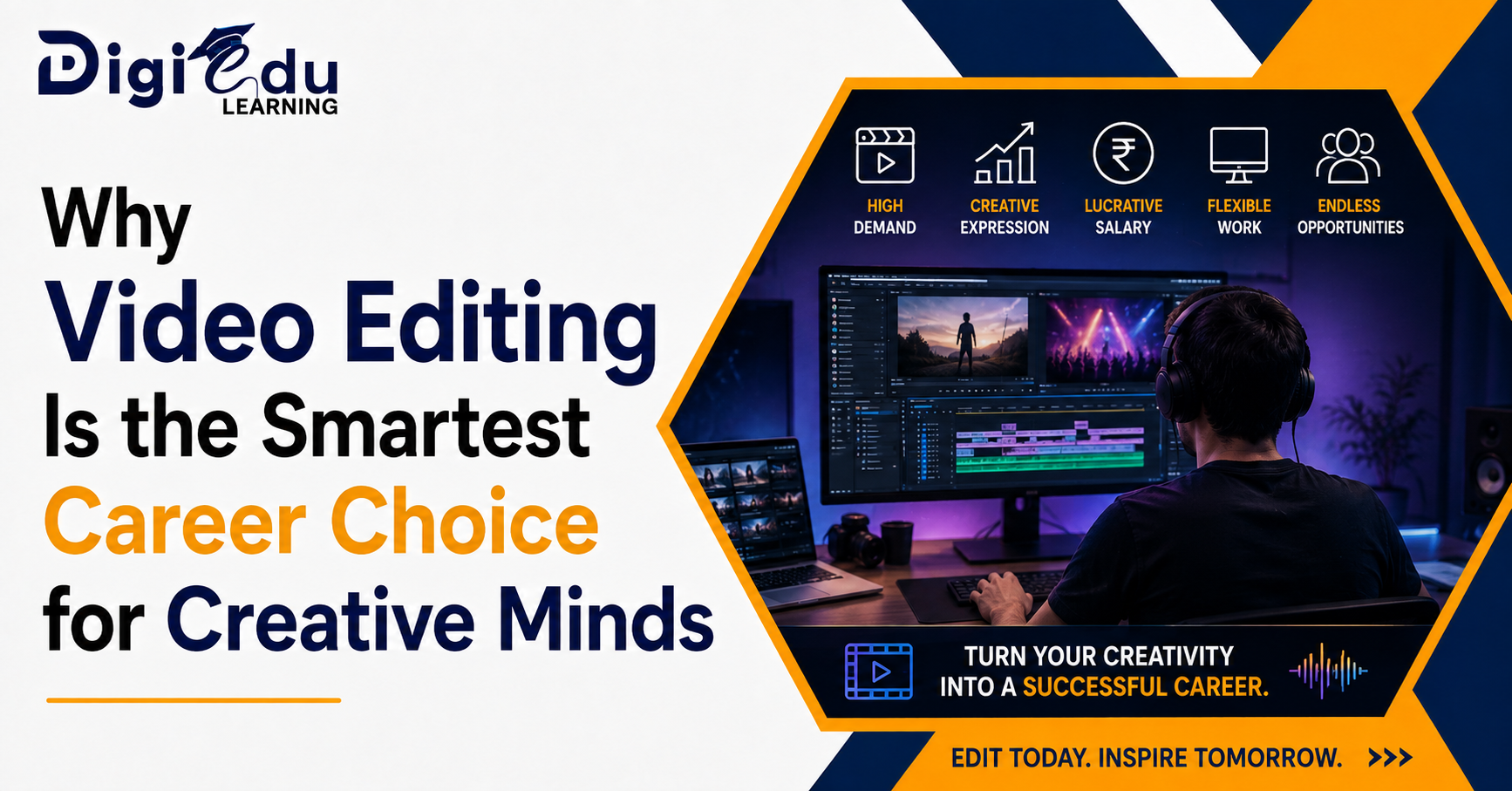
Why Video Editing Is the Smartest Career Choice for Creative Minds
A person completes their studies with a degree, some certificates, and one perplexing question: “What skill can I actually apply to earn?”
Meanwhile, a small businessman requires Instagram Reels, a creator needs YouTube video editing, a brand seeks short-form commercials, and an agency wants someone who can edit raw video material to make an interesting visual story.
This very difference is where video editing became especially useful.
For those people who find pleasure in storytelling, visual artistry, using new technologies, and digital media, there is one particular thing about the video editing career that seems very promising — namely, having a skill that can be applied in many different industries instead of just being relevant to one profession.
The industry itself develops very rapidly, as well. Artificial intelligence is making the process of video editing quicker, while creativity remains an essential part of determining the message of the story and what moments need to be highlighted.
Industry Insight
Videos have emerged as one of the core media for communication in social media, advertisements, education, entertainment, online business, corporate communications, and even in personal branding.
No longer do companies create videos only for broadcast on TV or in large-scale advertising campaigns. Companies now require short-form videos that can be used for various purposes, such as for their social media presence, product demonstration, customer testimonials, education, promotional campaigns, and even in internal communication.
It is this change in the industry that has increased the requirement for editors with skills beyond clip assembly.
That is one reason a video editing career can appeal to people who want a profession where technology and creativity work together.
The opportunity is particularly interesting for beginners because they can start developing a portfolio without necessarily waiting for years of formal industry experience. A strong collection of relevant work can demonstrate capability more directly than a resume alone.
Expert Commentary
A common mistake is to think that video editing simply means learning editing software.
Software is important, but professional editing depends on judgment.
An editor needs to understand why one shot works better than another, when a video is becoming too slow, how music affects emotion, how captions influence viewing, and how the final video should change according to its platform.
For example, a 30-second Instagram Reel and a five-minute YouTube video may use the same raw footage but require completely different editing decisions.
A professional editor should gradually develop several interconnected abilities:
- Storytelling to create a logical flow.
- Pacing to maintain viewer attention.
- Audio editing to make dialogue and music work together.
- Visual composition to improve the overall presentation.
- Typography and captions for clarity and accessibility.
- Platform awareness to adapt content for different audiences.
- AI-assisted editing to accelerate repetitive production tasks.
- Client communication to understand objectives and feedback.
This combination makes the skill much more valuable than simply knowing where different buttons are inside an editing application.
Video Editing Career Opportunities Are Expanding Beyond Traditional Jobs
One of the strongest reasons to consider this field is the range of professional paths available.
A person interested in editing can work with digital marketing agencies, production houses, brands, creators, educational organisations, startups, media companies, or directly with clients.
A video editing career can develop through several routes.
In-House Video Editor
Companies increasingly need dedicated people to manage their video content. An in-house editor may create social media videos, product videos, advertisements, training material, or corporate content.
Agency Video Editor
Digital marketing agencies often manage multiple clients simultaneously. This can expose an editor to different industries, content styles, audiences, and campaign objectives.
Freelance Video Editor
Freelancing provides flexibility and allows editors to work with multiple clients. Freelancers may specialise in Reels, YouTube videos, advertisements, podcasts, educational content, or personal branding.
Creator and YouTube Editor
Creators frequently outsource editing so they can focus on filming, scripting, and audience development. This creates opportunities for editors who understand a creator’s style and can maintain consistency across videos.
Short-Form Content Specialist
Reels, Shorts, and other short-form formats have created demand for editors who understand fast pacing, captions, hooks, visual changes, and mobile-first viewing.
The important point is that a career does not have to follow one fixed path. Someone can begin with freelance projects and later move into agency work, build a specialised editing service, or develop a broader creative career.
Proof & Real-World Perspective
Consider a hypothetical beginner who has learned basic editing.
Instead of immediately applying for every available job, they could create three portfolio projects: a short promotional Reel for a fictional brand, a YouTube-style educational video, and a product advertisement.
These projects demonstrate different abilities.
The first shows short-form pacing. The second demonstrates storytelling and longer-form structure. The third demonstrates commercial thinking.
Now compare that portfolio with a resume that simply says “Completed a video editing course.”
The difference is significant.
Creative industries often require evidence of what someone can produce. A portfolio gives potential employers or clients something tangible to evaluate.
This is why practical experience matters so much in a video editing career. Even self-created projects can become useful portfolio pieces when they are thoughtfully planned and professionally executed.
Analysis
The biggest advantage of video editing is its transferability.
A person does not have to work exclusively in entertainment to use the skill. Editing connects naturally with digital marketing, social media, advertising, education, personal branding, e-commerce, corporate communication, and content creation.
However, there are challenges.
The industry can be competitive, software and AI tools change quickly, and clients increasingly expect faster turnaround times. Beginners may also struggle when they focus entirely on technical features without understanding storytelling or business objectives.
AI is another important development.
AI can help with tasks such as transcription, captions, background removal, content repurposing, idea generation, and parts of the editing workflow. But it does not remove the need for creative judgment.
The strongest approach is therefore not to compete against AI but to learn how to use it effectively.
An editor who combines creative thinking with efficient technology can potentially produce better work in less time.
Recommendations
Anyone considering this career should focus on building a skill stack rather than learning one software application in isolation.
Start with the fundamentals of editing: cutting, sequencing, audio, transitions, captions, colour, and storytelling. Then learn how these principles change across different formats.
Build a portfolio around real-world use cases instead of random effects.
Create sample work for:
- Social media brands
- YouTube creators
- Businesses
- Personal brands
- Product promotions
- Educational content
Next, learn AI-assisted workflows. Understand which tasks can be accelerated without sacrificing quality.
Finally, develop professional habits. Meeting deadlines, responding to feedback, understanding briefs, naming files properly, and communicating clearly can be just as important as technical editing ability when working with clients.
For students and beginners, practical training can shorten the gap between learning a tool and understanding how it is actually used in professional work.
A good learning environment should therefore provide opportunities to practise, receive feedback, create portfolio pieces, and understand the expectations of real clients.
Closing Thoughts
A video editing career is no longer limited to traditional film and television production. The expansion of social media, creator businesses, digital advertising, online education, and brand communication has created many new ways for skilled editors to use their expertise.
For creative minds, the appeal goes beyond simply finding a job. Video editing combines storytelling, technology, visual communication, and problem-solving in a skill that can be developed into employment, freelancing, or an independent creative service.
The smartest approach is to learn editing fundamentals, practise consistently, understand modern content formats, use AI intelligently, and build a portfolio that proves what you can do.
At Digi Edu Learning, practical digital skills are designed to help learners understand how modern creative and marketing tools can be applied beyond theory. For anyone exploring creative digital careers, learning video editing can be a practical step towards building a skill that grows with the changing content economy.
Popular News



Our Partners