
Which SEO Skills Separate Job-Ready Candidates From Students Who Have Only Completed a Certification?
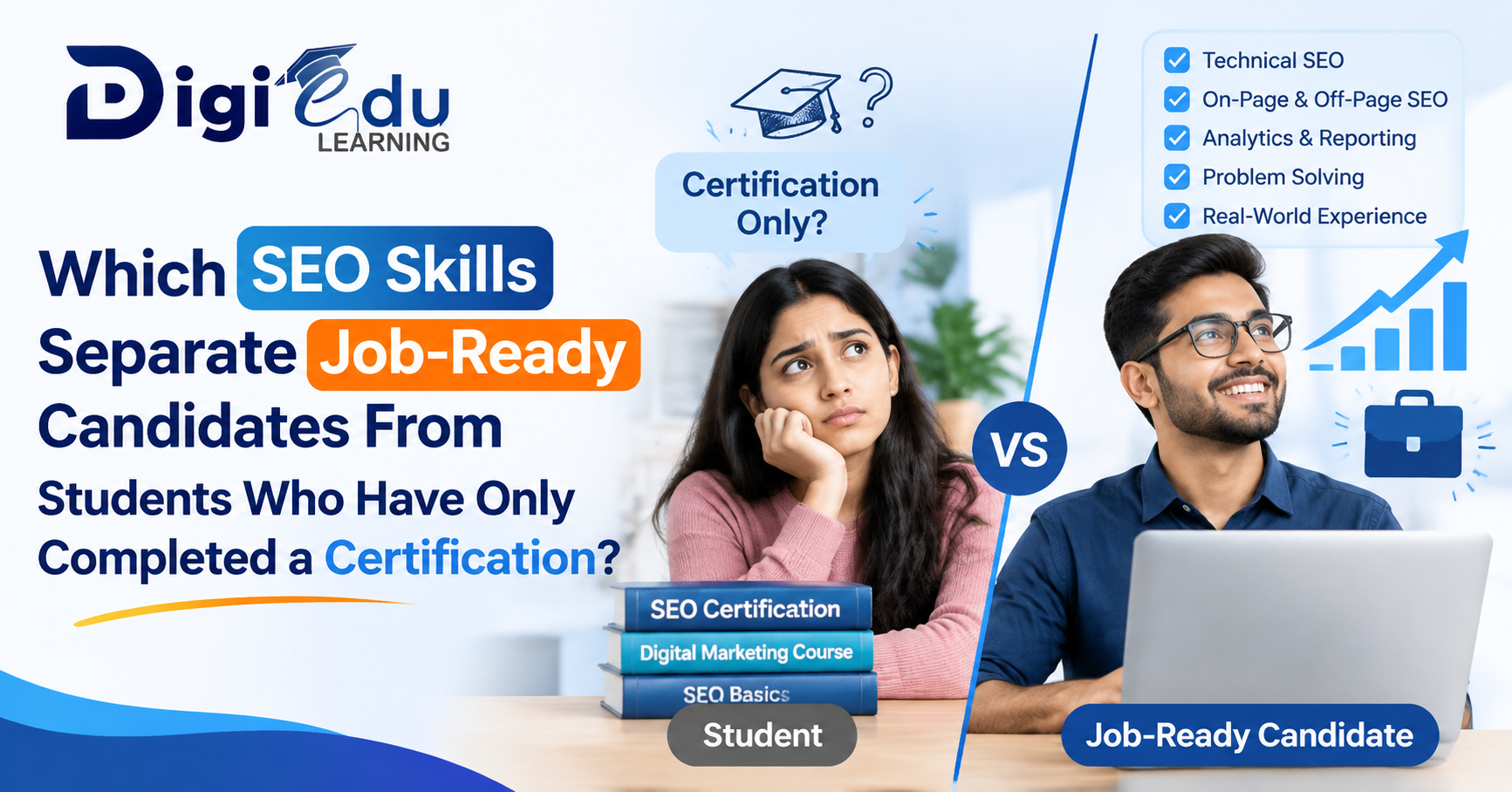
SEO certification is a good place to start for those who want to make a career in digital marketing. But learning SEO and implementing SEO on websites are two very different things. It is crucial that the potential employee has the ability to do keyword research, identify issues with a website, analyse its performance, and suggest ways to improve it in order to benefit the business. Having a certification does not imply the presence of such skills. Students and freshers from India need practical experience to be able to get a job. Digi Edu Learning teaches aspiring digital marketers about it.
Selecting the Best SEO Course in Faridabad could be a wise decision for those who want to know about SEO tools, learn about SEO techniques, and prepare themselves for the tasks that an entry-level SEO needs to do. But then again, what differentiates a ready-to-work candidate from a certified one? The difference is the ability to apply the knowledge.
1. Keyword Research and Search Intent
Another fundamental skill that SEO training courses teach their learners is keyword research. But those who are ready for employment know that successful keyword research is not limited to identifying those keywords that have high search volumes. The main thing is to understand the expectations of the user when he enters a certain search phrase in Google. For instance, the person who searches for “what is SEO” expects to get an answer. Meanwhile, the one who searches for “SEO course in Faridabad” is comparing offers. The search phrases demand two different approaches to the content creation.
For example, the digital marketing institute could seek to attract those who are interested in learning SEO. Instead of concentrating only on popular keywords, the SEO specialist could carry out research about the queries regarding the course and recommend pages that would assist in answering the queries of potential students. The aim is to match the keywords with the relevant content.
2. On-Page SEO and Content Optimisation
It is not sufficient to have information about the definition of on-page SEO. The candidate should be able to do the optimization of the pages in such a way that search engines know what it is all about, and the visitors get the right information. This will include writing title tags and meta descriptions, organization of headings, optimization of internal links, proper use of keywords, and understanding the purpose of the page. Service pages should explain what you offer and allow visitors to take some further actions. Posts should include answers to the questions asked by people and helpful tips. Candidates who are ready for work should be able to recognize the missing data, make the most of the page structure, optimize the images when necessary, and recommend some internal links.
As an example, if the page uses the proper keywords but gets very few clicks, then the candidate needs to analyze the page ranking in the search engines, relevance to the keyword, and the pages that are competing for the same keyword.
3. Technical SEO and Website Auditing
Technical SEO is a critical area that makes students with actual experience stand out from theoretical ones. Candidates may have knowledge about how crawlers work and website indexing, but they will also need to be aware of typical problems that websites have. In technical SEO, it is all about making search engines to find, to reach, and to understand website pages. This practice requires analysis of site structure, indexation, redirects, etc., things that might have an impact on a website’s position in search results. Some things that will be helpful to study are XML sitemap, robots.txt file, canonical URLs, broken links, mobile-friendliness, page speed and Core Web Vitals. One cannot be required to fix everything, but one knows how to look for the source of the problem.
For example, if there is a critical page that does something useful but which isn’t indexed by Google Search, then the candidate should know how to investigate problems like indexing, internal links, canonicals, and others. Learning how to do basic website analysis helps the student to structure his or her thinking when facing SEO challenges.
4. Google Search Console and Google Analytics
SEO decisions must be evidence-based where possible. People who are knowledgeable about reporting tools can make an assessment of the site’s performance and identify areas that could be improved. Google Search Console assists people in assessing search performance using various metrics, including clicks, impressions, CTR, and average ranking. In addition to the above, Google Search Console offers information on indexing issues, amongst others. Google Analytics assists businesses in making sense of website activity, user interactions, and conversions where proper tracking is set up.
For instance, a web page may have high impressions but few clicks. This is an indication that there is a need for the candidate to look at the title tag, search intent, or how the page looks in the search results. But from just the numbers, the exact cause cannot be determined. Again, if the organic traffic is high but the inquiries are low, there is need for the candidate to look at the landing page relevance and conversion tracking before making any recommendations.
5. Competitor Analysis and SEO Strategy
A competitor analysis goes beyond imitating the keywords and content used on other websites. A job-ready candidate uses this analysis to learn how to optimise their website in practice. The competitor analysis could involve looking at the topics, keywords, internal links, structure, and the information provided by the competing websites. For example, the competing sites may describe a particular topic in brief. There could be an opportunity for a business to produce a useful guide for answering the questions associated with that topic and giving appropriate examples. It should be based on the analysis, not on guesses of what is lacking on other websites. Candidates should know that not all the keywords need to be considered right away.
The method of SEO which considers business goals, target audience needs, competitive conditions, available resources, and possible impact of actions is very helpful in working with an agency or marketing department.
6. Local SEO for Businesses in India
Local SEO is especially helpful to businesses that have customers in specific cities and areas. Training institutes, clinics, restaurants, and service providers may require visibility when customers search for them by their location. It is important for candidates to be familiar with Google Business Profile optimization techniques, accurate listing of business details, local keyword research, and management of local business listings. It is also important for them to be aware of the value of reviews and consistency in business listings in order to build trust locally. For instance, a training institute in Faridabad may require course pages that are beneficial for local students.
Adding a city name continuously to your content will not constitute a good local SEO strategy. The candidates should know the connection between the business, the services, the location, and the searchers of the services. Local SEO awareness can help newbies add value to the campaigns of businesses that require nearby customers.
7. Link Building and Backlink Quality
Backlinking is yet another field where practical knowledge comes in handy. A job-ready SEO specialist realizes that link building is not about getting as many links as possible. He needs to have the knowledge of how to evaluate the relevance of the links, find out the competitors’ backlinks, find valid opportunities for outreach, and distinguish practices which might break search engines’ anti-spam policies. For example, it may create an original guide or resource that would be valuable to relevant sites. An SEO specialist finds the proper places to do outreach and explains its value.
Candidates should not depend upon automated linking schemes or irrelevant links just to boost their backlinks. Furthermore, candidates should be aware that metrics for backlinks from third parties are estimations and not an exact measure of Google’s ranking process. The skill to analyze the quality, relevance, and risk of links is more useful than the number of backlinks.
8. SEO Reporting and Communication Skills
The SEO expert needs to document his/her work as he/she carries out the tasks. The SEO expert may need to write progress reports, communicate with the development team regarding technical issues, collaborate with content writers, or even report on the success of the campaigns to his/her clients. A competent job candidate should be able to document achievements, analyze metrics, and come up with recommendations. Reports should clearly document what has been done and any challenges that require further investigation or action. For instance, if there is a reduction in organic search clicks, the job candidate should find out the root cause of the problem which could be reduced ranking, search volume, technical issues, or content issues.
It also implies setting up realistic expectations. SEO results do take time to show themselves and are subject to many variables. Making any guarantees of certain positions without any grounds for that is not a professional approach. Good reporting and communication can establish trust and ease collaboration.
9. Practical Projects That Demonstrate SEO Knowledge
A person does not necessarily have to wait until they get their first job in order to develop such skills. SEO can be practiced by students using either personal sites, sample work, or even website projects approved by teachers. The portfolio will show how a candidate solves a problem and what methods they use.
Useful activities include:
- Keyword research: Make a list of keywords and classify them according to their search intent.
- Website audit: Determine the basic issues that exist with regard to technical, content, and on-page SEO.
- Content strategy: Connect the keywords with the right web pages and make a content calendar.
- Use of tools: Learn how to use Google Search Console and Google Analytics for data.
- Performance analysis: Data analysis like clicks, impressions, etc.
- Creation of case study: Problem, change made, and outcome obtained.
A case study provides candidates with a practical topic that they can talk about during their interview process. Any small project will show initiative, analytical skills, and knowledge of SEO. The candidates need to be honest about their work and not present sample tasks as paid client tasks.
Choosing the Best SEO Course in Faridabad for Career Readiness
In comparing training programs, students are encouraged to go past the certificate aspect and consider the skills that are being taught. The Best SEO Course in Faridabad is supposed to be balanced in terms of theoretical and practical learning on topics such as keyword research, on-page optimization, technical SEO, content planning, analysis, and reporting. Students need to ensure that they get trained on website auditing, use of SEO tools, assignments, and handling realistic situations. Feedback and how errors are rectified by the trainers are important factors to consider.
A structured course makes learning easy through guidance and helps students learn from basics to application. But just finishing a course will not ensure getting a job. Practice, communication, and explaining your work are still necessary. Select a course according to your existing knowledge, future plans, and requirements, not based on marketing alone.
Conclusion
One of the main distinguishing factors of a student of the SEO certification program from one who is job-ready is whether he can put his knowledge to practice. Keyword research, On-page SEO, Technical SEO, analytics, competition analysis, local SEO, and reporting – all of these skills assist one to become job-ready. Joining the best SEO course in Faridabad will ensure students can acquire all these skills and be prepared for job positions in the field of digital marketing. It will be much easier for students to succeed in entry-level SEO positions once they have these skills. A certificate will be helpful for your education process, but real skills will demonstrate your abilities.
It is possible that Digi Edu Learning will help you begin your journey into SEO training and the development of knowledge and skills required to enter the realm of digital marketing. Remember to learn constantly, analyze your performance honestly, and practice.
Frequently Asked Questions
1. Will an SEO certification be enough for getting a job?
An SEO certification will help prove that you have knowledge of the basics. Employers can check not only this knowledge but also other skills such as your practical knowledge, experience with the tools used in SEO, problem-solving skills, and an explanation of how your work was done.
2. What SEO Skills Should Beginners Start with?
Beginner SEOs can start learning about keywords, search intent, on-page optimization, on-site linking, content optimization, and Google Search Console. The next SEO skills are technical SEO, analytics, local SEO, and link building.
3. Do SEO specialists need to know coding?
Not every SEO specialist needs advanced coding skills. But knowledge of basic HTML and website structure will help SEO specialists to find some technical problems and talk with developers.
4. How can students get SEO experience without having a job?
They can practice on their own websites, test websites, or authorized projects. They can do research on keywords, conduct website audits, optimize pages, analyze results, and create a portfolio.
5. What should students be aware of before joining an SEO course?
The things to keep in mind include the curriculum, practical assignments, tool learning, projects, and assessment methods. Moreover, students should make sure that the course includes both technical and content SEO knowledge.
Popular News



Our Partners