
How Can You Tell Whether a Digital Marketing Course in Faridabad Teaches Strategy or Just Individual Marketing Tools
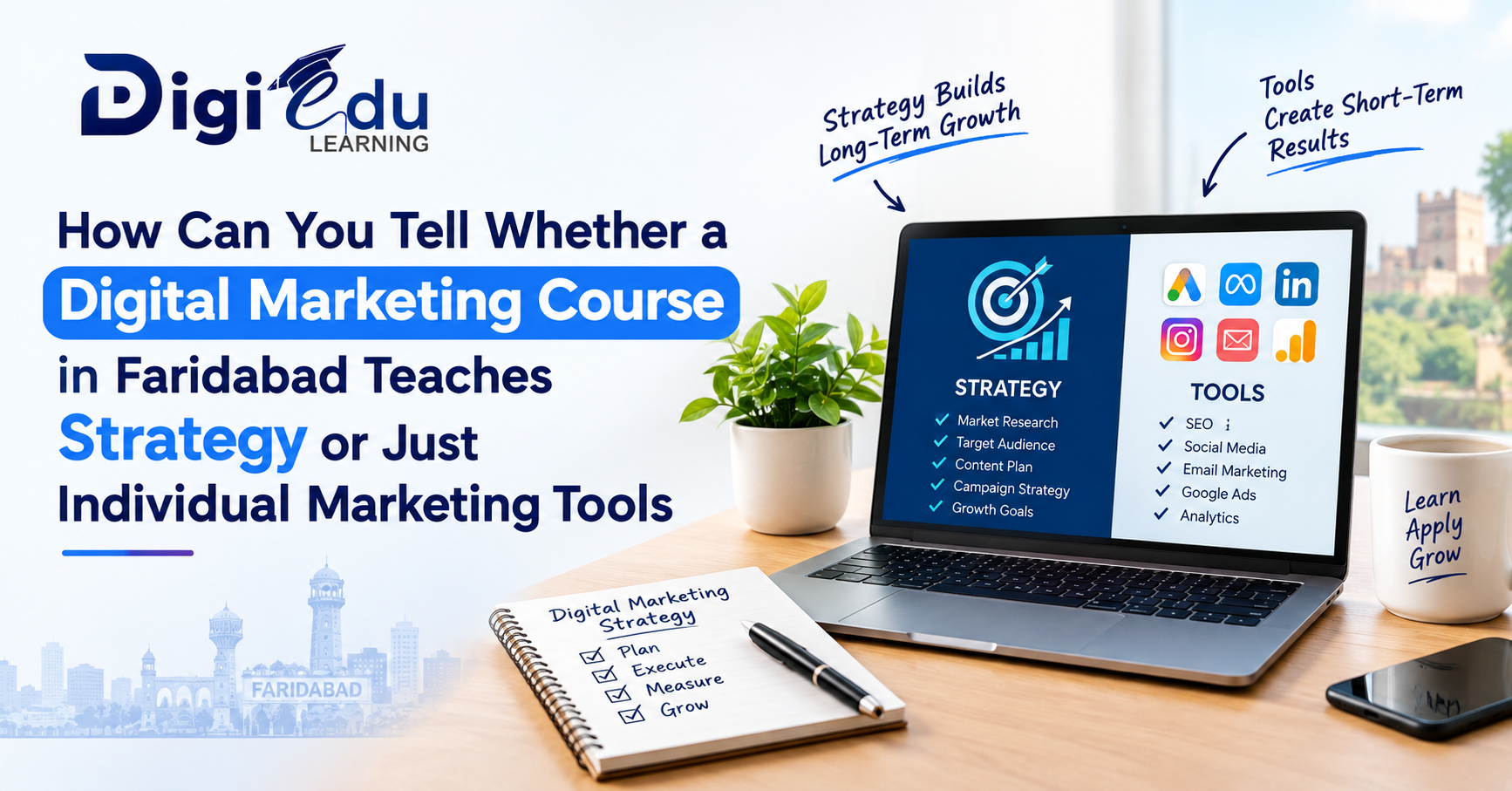
The selection of a digital marketing course is indeed an essential step for creating a career in digital marketing. But not all courses will be able to equip you with an understanding of digital marketing as a whole. Most courses only emphasize learning about the individual tools, like Google Ads, SEO tools, social media dashboards, and analytics tools, but not how these tools can help achieve business objectives. An ideal Digital Marketing Course in Faridabad will ensure that you learn to use marketing tools and make decisions.
In Digi Edu Learning, a learner can judge his or her digital marketing training experience through the ability to move away from the list of tools taught in the syllabus. The actual question is whether or not the course you have enrolled in enables you to appreciate why you need to conduct a certain marketing practice, what time frame it should be conducted in, and how to measure its success.
Why a Strategic Approach Matters in a Digital Marketing Course in Faridabad
There are many things that go hand-in-hand with digital marketing, such as search engine optimization, paid advertising, social media marketing, content marketing, email marketing, and performance analysis. All these have an important role to play, but their efficiency is determined by how well they fit into the whole marketing strategy. The ability to develop a Google Ads campaign is important. However, a marketer needs to know more than just that; he or she needs to know the target audience, the objective of the campaign, the destination landing page, and the efficiency of the budget used in advertising.
That is where strategic learning comes into play. A tool-based course would be able to teach you how to do certain things. A strategy-based course will tell you what things should be done in the first place. Look at these examples:
| Tool-Focused Training | Strategy-Focused Training |
| Teaches how to use marketing platforms | Explains when and why to use each platform |
| Focuses on individual campaign settings | Connects campaigns with business objectives |
| Covers separate marketing channels | Shows how different channels work together |
| Explains basic performance metrics | Teaches how to interpret metrics and improve results |
| Focuses on completing tasks | Develops planning, decision-making, and problem-solving skills |
Both types of learning have value. You need practical tool knowledge to execute campaigns, but strategic understanding helps you decide what to do and how to improve performance.
1. Check Whether the Course Starts With Business Goals
An example of when a training process can be said to be strategic is when a company starts with its goals and not how to demonstrate the software application. It is necessary to know the objective of the campaign before initiating any marketing activity. The objective might be to have more customers, increase sales, or enhance the brand name.
For example, the local coaching center needs more inquiries from students. The marketing strategy may include local SEO, useful educational content for education, advertising, and a landing page to get more inquiries. Simply educating the students about posting on social media is not enough. When selecting the course, make sure that it includes:
- Identify the marketing objectives of your business.
- Identify the target audience and their needs.
- Select the right media for your marketing.
- Identify the objectives of your marketing campaign.
- Plan your activities based on your budget.
- Assess if the outcome justifies the initial aim.
If the curriculum links marketing activities with business results, there is a higher possibility of developing strategic thinking.
2. Look Beyond the List of Tools in the Syllabus
A syllabus that contains many popular marketing platforms looks quite impressive. Nevertheless, the number of tools that are used in a course does not necessarily mean its quality. Marketing platforms change their dashboards, functionalities, and reports. Students need to know the basics of those tools rather than just how to operate the dashboards. For example, it is important to know how to use Google Analytics; however, it is much more important to know what the data tells about the visitors’ behavior. Moreover, it is necessary to know how to schedule social media posts, but that requires more knowledge.
Before joining a Digital Marketing Course, find out if the course discusses why every tool should be used by your business for a certain goal. Is it made clear that SEO will be more suited than paying for advertisements to achieve that goal? Is it illustrated how social media posts can help in achieving your overall campaign goal? Do they learn how to analyze outcomes and suggest better ways?
3. Find Out Whether You Will Learn to Build a Marketing Strategy
An effective digital marketer must be in a place where he or she can plan the marketing approach before implementing the plan. This entails coming up with the target audience, conducting competitor analysis, choosing an effective channel, formulating the content, having a budget if necessary, and knowing how success is going to be measured. The strategic approach should enable the learners to be familiar with the formulation of the marketing approach. For example, consider the scenario of a small business that wants to improve its sales using the website. Before suggesting the use of advertisements, a marketer should first analyze the website and know the products, the customers, and the competitors.
The resulting strategy might require optimizing the product pages, creating SEO content, implementing paid campaigns, and monitoring the conversion rates. All of that would depend on the situation at the company and its objectives. When going through your homework, do your best to look for tasks where you would need to create a marketing strategy, select the channels, pick up the KPIs, and discuss the ways to improve the performance of your campaigns. That would allow you to move from just completing the instructions to making decisions for the company.
4. Check Whether Practical Projects Connect Different Marketing Channels
Training is important, but not all training processes help develop strategic skills. Writing content for your post, creating an example ad, or conducting keyword research can help you learn how to do it. A process of combining different actions allows you to see digital marketing from a more complete perspective. Here is what to look for in your course:
- Creation of a digital marketing strategy for the sample company.
- Investigation of target audience and competitor.
- Development of SEO and content strategies for the website.
- Campaign planning on the basis of an objective.
- Data analysis and suggestions for improving the campaign.
- Integration of Landing Page, Content, and Promotion for Conversion.
Imagine a firm that gets traffic on its website but not many inquiries. The tool-based learner will quickly suggest increasing the budget for advertising. The strategically trained learner will first look into the matter. This could be because of irrelevant traffic, poor communication, a bad landing page, or a complicated process of inquiry. Knowledge about the actual problem will enable the marketer to choose the best possible remedy. Linking these things is one of the most important skills acquired through actual experience in digital marketing.
5. Evaluate How the Course Teaches Analytics and Decision-Making
The performance of the digital marketing campaigns cannot be determined on the basis of activities. Just because you create more content, publish more ads, and create more visits doesn’t mean your campaign was a success. Any good class would teach you to measure the impact of your hard work and make decisions on the basis of numbers. The metrics you’re going to measure are going to depend on the objective of the campaign itself. For example, for a lead generation campaign, your metrics would include CPL and Conversion Rate.
What matters most here is the interpretation of the numbers and what should follow after. Ask if the course will cover the ability to interpret the report, compare the outcomes with the objectives set, identify areas where you are weak, and make suggestions for improvement. It is important for you to know that any number by itself can be misleading without context. For instance, while one marketing campaign may bring in a lot of enquiries, it could be performing badly if those enquiries are not relevant or not likely to turn into customers.
6. Ask Whether Trainers Explain the Reason Behind Their Recommendations
The way in which the course is taught is equally significant as what is being conveyed through the course content. A class that is focused on techniques will involve demonstration of a procedure by the teacher followed by practice of the same by the students. This approach is good for new learners, but little else.
Strategic learning involves asking questions, comparing choices, and understanding the rationale behind marketing decisions. For instance, an instructor can tell you why one company would need local SEO while the other would require a paid search campaign. This would be in light of issues such as the intention of the customer, competition, budget, business goals, and the duration required to make things work. Here are some questions that you should ask before enrolling in a class:
- Will I be taught about how to select an appropriate marketing channel for an organization?
- Are students allowed to solve marketing problems on their own?
- Am I supposed to get feedback regarding my campaign strategy?
- Is the training concerned with the optimization and analysis of marketing campaigns?
- Are there examples of actual marketing solutions?
It is important to get clear answers to assess whether the studying process involves critical thinking or mostly follows a predetermined set of actions.
7. Review the Course Curriculum for Strategic Topics
The balance of a curriculum should consist of both execution ability and knowledge that would enable one to make good marketing decisions. One should be able to combine good marketing understanding with practical skills. The following checklist is provided for the comparison of courses.
| Curriculum Area | What to Look For |
| Marketing fundamentals | Customer journeys, audience research, positioning, and business objectives |
| SEO | Search intent, keyword research, content planning, and website optimisation |
| Paid advertising | Campaign objectives, audience targeting, budgeting principles, and optimisation |
| Social media marketing | Content strategy, audience engagement, and channel selection |
| Content marketing | Content planning, audience needs, and alignment with marketing goals |
| Analytics | KPI selection, reporting, performance interpretation, and recommendations |
| Practical projects | Campaign planning, implementation, evaluation, and improvement |
The curriculum doesn’t have to include all platforms to be efficient. The important thing here is if these topics complement each other and provide an understanding of the whole process of marketing. Besides, think about the amount of time spent on practical assignments, project reviews, and feedback from the tutors. An efficiently organized process of studying is more informative than a list of all software programs.
8. Identify the Skills You Should Have After Completing the Course
The best method of evaluating a course is to think about what you should be able to do at the end of it. If you can only follow the same process that your trainer has shown you, then your knowledge could be restricted to known processes. However, when you can analyze a new business, know what it requires for its marketing, choose appropriate media, and assess their effectiveness, you will have more skills. At the completion of a complete course, you should be able to:
- Determine marketing objectives and target customers.
- Conduct research related to keywords, competition, and customer needs.
- Make recommendations for digital marketing channels.
- Develop a marketing campaign with defined objectives.
- Carry out marketing activities through proper means.
- Analyze performance results and identify areas for improvement.
- Support your recommendations with logical reasoning and data.
These skills will come in handy whether you want to become an employee at an agency, be part of an in-house marketing department, or freelance. It is important to keep in mind that being through a class does not mean becoming a skilled strategist automatically. Being strategic is something one achieves through experience and exposure to various business problems. The class simply lays down the foundations for you.
How to Choose the Right Digital Marketing Training for Your Career Goals
While making the final decision, you should compare the courses depending on their learning outcomes and not simply on their cost, duration, or the number of tools that they have. In case your aim is to become a digital marketing executive, then the ability to work on the platforms is essential. However, if you are going to plan, analyze, or solve problems in the future, then those skills are necessary as well.
A good strategy would be to ask the program to provide its curriculum, ask for samples of applied tasks, learn how to perform an analysis, and how much help there is in working on projects. It would also be wise to think about your existing experience. Beginners may need more guided instruction on the basics of marketing in order to be ready for working on campaigns. Those who have some knowledge of the topic might get more out of complicated projects that require analyzing data and making independent decisions.
Conclusion
The selection of the digital marketing program is not confined to finding out whether the program teaches SEO, Google Ads, social media, and analytics. Rather, one must know how these tools work under a broader scheme of marketing. And how they help in meeting the objectives of a business. Such programs integrate the practical execution of marketing with its strategy. It not only trains a person on executing a particular job but also makes him/her realize why it should be done and when something else could be better.
For a Digital Marketing Course in Faridabad, consider checking its curriculum, find out if the program offers projects, and determine whether the course teaches decision-making skills based on evidence. In this way, it will be easier to pick the right training for future career development. Digi Edu Learning may serve as an initial step in your search for the right digital marketing course. When choosing, analyze the offered courses and check if their curriculum suits your goals.
Frequently Asked Questions
1. How does learning about the use of digital marketing tools differ from learning about digital marketing strategies?
Learning tools means using digital marketing platforms like advertising dashboards, SEO software, analytics applications, and the like. Strategy learning entails setting up business goals, knowing your audience, choosing proper channels for communication, and determining ways to improve.
2. What does a good digital marketing course comprise?
It should include such disciplines as marketing basics, SEO, paid advertising, social media marketing, content marketing, analytics, and projects. Also, the course should demonstrate how all these aspects complement each other when working towards business goals.
3. How do I make sure that a digital marketing course gives practical training?
You may ask whether there are live or simulated projects, campaign planning assignments, performance analysis training, and feedback from trainers. You may also ask for samples of tasks performed by students during the course.
4. Are digital marketing tools alone sufficient to help me get employed?
Digital marketing tools may assist you in completing certain activities, but employers may require you to have communication skills, analytical and problem-solving abilities, as well as knowledge of marketing goals. Acquiring both technical and theoretical marketing skills will increase your chances of employment.
5. How can I select the correct digital marketing program being a novice?
First of all, you can take a look at the course program, training style, practical tasks, and assistance from teachers. Opt for a training program that will teach the basics, allow you to practice, and understand the process of making marketing decisions.
Popular News



Our Partners