



Why Traditional SEO Metrics No Longer Measure Real Marketing Success In 2026
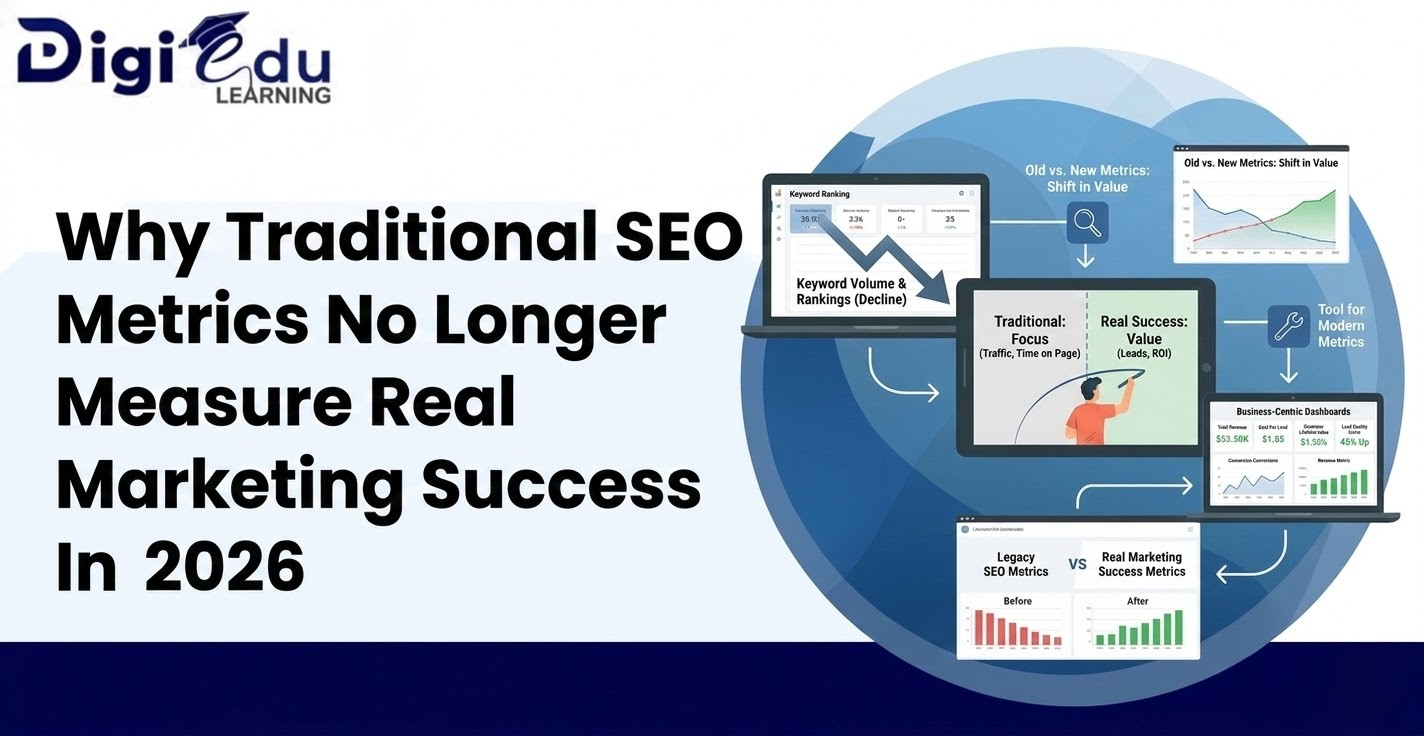
In the dynamic digital nature, companies can no longer use the old performance measurement techniques to determine online expansion. Over the years, marketers used the placement of key words, back links and the volume of organic traffic as the measures of success. Whereas these pointers previously determined the performance of SEO, 2026 has transformed the very concept of digital success.
Search engines today are no longer about surface measuring. Companies that keep on trying to pursue the vanity metrics tend to fall behind, whereas those that pay attention to the actual value of the user grow successfully. We help organizations take part in this change at Digi Edu Learning by matching the strategy to current search behavior, artificial intelligence-driven algorithms, and optimization of the user first.
We should investigate the reasons why the old indicators are not the measures of marketing success anymore and what really matters in 2026.
The Shift from Rankings to the Real Business Impact
Over ten years, being first in Google was regarded as the final aim of the SEO. Higher positions were taken to be equated with higher traffic and hence higher conversions. This equation is not secured anymore.
Now, search engines are more personalised, AI-created summaries are provided and contextual answers are given priority. Consequently, ranking positions are always changing and may not even be effective in generating clicks as they used to be.
Business impact is what is important in 2026 not the visibility alone.
Why Ranking Alone Is Not Sufficient
A top position of 1 is not necessarily associated with revenues. Most of the businesses deal with high traffic yet their conversion rates are poor most of them are interested in being seen and not aligned to their intentions.
For Example:
- A blog could position itself to a high volume key word, but get the wrong users.
- The users can get answers on AI-based sniping features without necessarily going to the site.
- Traffic can go up, yet the engagement statistics are low.
This shows that the standard ranking measures are impotent in terms of the measurement of meaningful involvement and revenue creation.
The Emergence of A.I. and Zero-Click Search
Search engines are now powered by AI and display summaries, voice results and chats in real-time. Users do not have to click a link to a web site to get the required information.
This change implies that marketers will have to optimize:
- Brand authority
- Topical expertise
- Structured content
- Conversational queries
Ranking is no longer a key to modern SEO success that relies on citations, trustfulness, and relevance.
The New Performance Indicators Are User Experience and Intent
In 2026, the search engines will use the signals of user satisfaction to rank websites. The time on page, level of interaction and returning numbers is a better metric than the raw traffic number.
Search algorithms determine whether your content actually resolves the problems of users. It is why user experience (UX) and intent optimization are important pillars of a modern digital strategy.
Engagement Interaction Metrics Is More Important Than Traffic
Businesses now measure success using:
- Conversion rate
- Scroll depth
- Session quality
- Customer lifetime value
- Assisted conversions
A site with 5, 000 well-targeted visitors can perform better compared to one that has 50,000 un-targeted users.In Digi Edu Learning, we advise businesses to pay attention to growth in data and not only its exposure.
Intent to Search Keyword Density
In the past, the important SEO strategies were the keyword density and the exact-match optimization. In 2026, algorithms interpret semantics, context and user intent further than ever before.
Search engines now evaluate:
- Topic clusters
- Content authority
- Contextual relevance
E-E-A-T (Experience, Expertise, Authoritativeness, Trustworthiness)
It is no longer possible to achieve results by simply repeating keywords. Rather, the content has to respond to stratified questions and give holistic solutions.
Brand Signals and Authority
Search engines have started taking into account brand reputation, online mentions, reviews and authority signals. When people can find your brand name when they search it, when they can find your content, when they mention your expertise, that builds your credibility online.
Contemporary SEO is related closely to branding, PR, and content marketing. To succeed with business within the search engines, businesses need to establish trust beyond search engines.
The Reason Why Backlinks and Traffic are no Longer Sufficient
Once backlinks were used to dominate optimization strategies. Rankings were highly manipulated by the agencies that emphasized on link-building campaigns. Although back links are still important, their quality and relevancy to the context are more important than their numbers.
Poor quality links do not offer sustainable outcomes anymore. The search engines are now able to detect unnatural link patterns and give priority to actual authority.
Quality over Qunatity Matters in Link Building
One authoritative mention in an industry is worth more than dozens of low quality directory links.
Increasingly, link strategies in 2026 entail:
- Digital PR
- Thought leadership
- Research-based content
- Strategic collaborations
It has ceased to focus on link acquisition and has shifted to brand credibility.
Traffic Not Accompanied By Conversions Is Worthless
Most companies rejoice with an increased traffic without conversion data. Traffic is, however, not revenue-generating in itself.
What matters is:
- Are visitors taking action?
- Are leads qualified?
- Is revenue increasing?
Contemporary marketers have analytics based on ROI, as opposed to vanity metrics.
The Integration of SEO-Holistic Digital Marketing
Search optimization has ceased to be a separate functionality. It now integrates with:
- Content marketing
- Social media strategy
- Paid campaigns
- User experience design
- Data analytics
An effective SEO plan in 2026 must be inter-departmental. The marketing teams need to make goals consistent so that all the digital touchpoints are on the same track.
Data-Driven Decision Making
The predictive insights are no longer available in historical data only; now advanced analytics tools are used. Companies are able to predict trends, patterns of behavior and to narrow down strategies ahead of time.
Companies are no longer driven to react to ranking drops but instead, they are optimizing on the basis of user journey mapping and behavior tracking.
Personalization and Predictive Search
Search engines are becoming more and more personalized in terms of user history, location and behavior. This implies that all the users can have varied results on a given query.
In order to remain competitive, companies need to develop flexible content strategies that can meet a variety of user personas and purchase phases.
Conclusion
The measures that were used to measure the effectiveness of SEO used to be traditional, and in 2026 the rules are completely different. Ranking, traffic volume, and the number of back links is no longer sufficient to ascertain whether your promotional activities are bearing fruits or not. It is time to focus on the actual business growth conversions, customer interaction, brand equity, and value generation in the long term.
Those firms which are no longer preoccupied with vanity metrics but concentrate on user-world strategies will occupy the digital arena. On Digi Edu Learning, we enable brands to adopt contemporary optimization strategies, which are consistent with the changing search patterns and algorithms of AI.
The future of SEO is not going to be the pursuit of numbers, it will be the meaningful experiences, the establishment of trust, and the ability to make an impact measureable. Those businesses that recognize this change will not only survive in 2026 but they will be doing well.
Popular News

Our Partners





Leave a Reply