



Why Skill-Based Learning Will Outperform Degrees in Digital Marketing
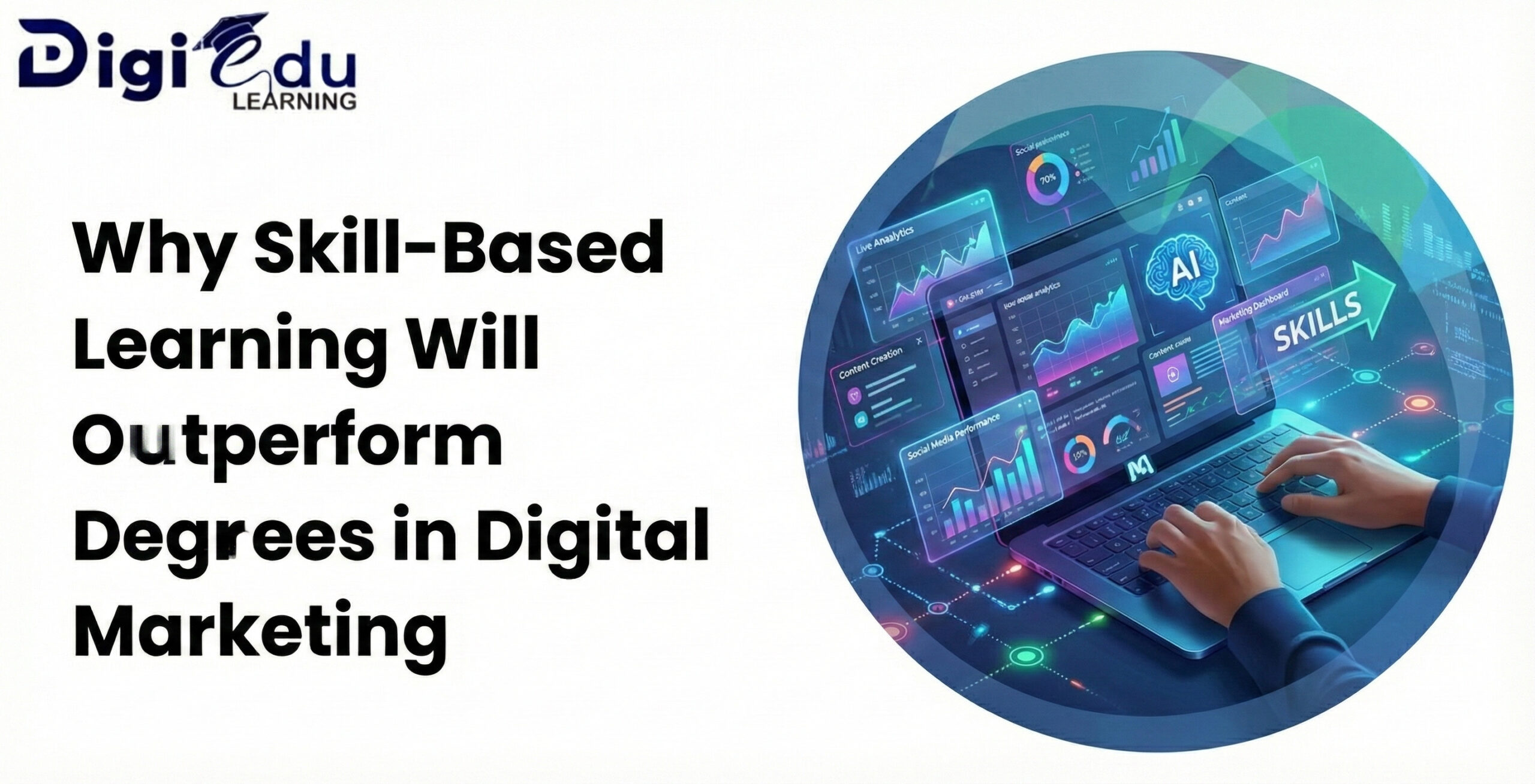
Digital marketing is not a profession that is led by theory anymore. By 2026, brands will require marketers to plan promotions, run advertisements, optimize funnels, analyze performance, and provide a measurable ROI within the first day. The problem with traditional degrees is that they find it difficult to keep up with this speed due to the fact that digital marketing platforms, algorithms, and tools change more rapidly than academic programs. Owing to this, the future of a successful career in digital marketing is being realized through skill-based learning. This is not a change towards not being educated, but rather focusing on practical skills as opposed to fixed qualifications.
Why the Digital Marketing Industry Is Moving Beyond Degrees
Google, Meta, LinkedIn, AI platforms, and automation are the forces that drive the digital marketing ecosystem with endless updates. It may take years to revise a university syllabus, and within months, practices in the industry will change. Marketers now have to have immediate knowledge of paid advertising dashboards, SEO tools, analytics platforms, content systems, and AI workflows. The learning based on skill-based learning remains in touch with this fact because it is centered on recent tools and actual campaigns, as well as performance outcomes, instead of the theory-intensive programs in the long term.
The Gap Between Academic Education and Industry Expectations
The majority of the digital marketing degrees are based on general marketing, business communication, and business management theory. Although they are valuable concepts, they will seldom educate a student on how to create a Google Ads campaign, how to optimize SEO content, how to conduct A/B tests, and how to analyze GA4 data. Degrees are no longer the wonder of employers. They desire marketers to show the ability to perform and know their tools and how to perform faster. Skill-based learning bridges this gap by imparting skills to the learners on how agencies and companies conduct themselves in the modern world.
Why Skill-Based Learning Fits Modern Marketing Careers
The tasks of digital marketing require flexibility, exploration, and constant optimization. Skill-based learning reflects this environment as it facilitates the learners to practice, fail, improve, and repeat. Rather, learners will solve live projects, simulate real clients, and develop strategies based on the data. This strategy fosters self-belief and ability at the same time, rendering learners work-fit instead of degree-qualified.
Core Advantages of Skill-Based Learning in Digital Marketing
1. Real-World Campaign Experience
Skill programs are skill-oriented and are execution-based as opposed to passive-based programs. Students complete SEO audits, paid advertising campaigns, content plans, and analytics dashboard modeling of actual industry situations. This is an experience that makes them realize how digital marketing works in reality and not in books.
Key benefits:
- Live tool and platform exposure.
- Knowledge of campaign execution and optimization.
- Good faith to deal with actual marketing assignments.
2. Faster Career Readiness
The conventional degrees can take three to four years to graduate, whereas skill-based learning can train learners to take entry-level jobs within months. This pace is important in the industry, where experience is more important at a young age than lengthy school schedules. Students can begin working as freelancers or interns, or do full-time jobs at a much earlier age.
Key benefits:
- Faster access to the same.
- Early earning potential
- Less time spent compared to degrees.
3. Tool-Centric Learning Approach
Digital marketing is technology-inspired. Skill-based learning will focus on proficiency in such systems as Google Ads, Meta Ads Manager, SEO tools, analytics, CRM systems, and AI-based marketing systems. The introduction of these tools in degrees is usually theoretical, whereas skill-based education provides students with the ability to apply these tools in practice in their everyday lives.
Key benefits:
- Practical experience working with industry-standard tools of industry standard.
- More in line with employer requirements.
- Real knowledge of workflows and dashboards.
4. Industry-Relevant Curriculum
Skill-based learning is always flexible with the market demand. Training modules are updated in a short period, incorporating new platforms, AI features, and changes in algorithms. This would make sure that the learners will be continuously using current strategies and not old-fashioned case studies.
Key benefits:
- Revised learning in line with the present trends.
- Applicability in other fields.
- Increased long-term employability.
5. Performance-Based Evaluation
Skill-based learning does not measure performance in terms of exams or theoretical tests, as in the case of degrees, but through projects, campaign outcomes, and practical projects. This model depicts the way in which marketers are assessed in real working situations.
Key benefits:
- Outcome-focused learning
- Explicit indication of ability.
- Career development based on a portfolio.
6. Even better freelance and entrepreneurial opportunities
One of the most rapidly developing freelance industries is digital marketing. Learners who are skill-based are trained to deal with clients, pricing, reporting, and campaign delivery. Freelancing or client management is barely touched on in degrees.
Key benefits:
- Early freelance readiness
- Client acquisition skills
- A marketing mindset that is business-oriented.
7. Economical Professional Investment
Degrees are usually expensive in terms of tuition, time, and other costs. Skill-based learning also provides targeted training at a significantly lower price and is thus more accessible and ROI-based.
Key benefits:
- Lower financial burden
- Higher return on investment
- Low-cost entry point into a career.
8. Portfolio Over Certificates
Portfolios are important in digital marketing as opposed to certificates. Skilled students leave with actual campaign reports, ad creatives, search engine audit reports, and analytics dashboards. The assets enable candidates to be outstanding in their interviews and client pitches.
Key benefits:
- Strong proof of work
- Increased interview performance.
- Increased trustworthiness with employers.
Why Employers Are Prioritizing Skills Over Degrees?
In agencies and startups, recruitment managers expect applicants to produce results instantly. It requires time and money to train a degree holder. Skilled learners minimize the effort of onboarding since they are already conversant with the tools, processes, and expectations. This makes them a better hire without traditional degrees.
How Skill-Based Learning Supports Long-Term Growth?
The digital marketing profession involves lifelong learning. The learning that is based on skills forms an attitude of continuous betterment, experimentation, and the ability to adapt. Students get to be comfortable with the new tools, test strategies, and change responses. This flexibility guarantees a sustainable career in an industry that has a dynamic nature.
Conclusion
Skill-based education is competing better than traditional degrees in digital marketing since it is directly related to the requirements of the industry, implementation of its application, and expectations of employers. It trains learners at a quicker rate, provides them with practical experience, and constructs portfolios applicable in the employment sector. At Digi Edu Learning, students are trained through practical projects, industry tools, and real-world mentorship to ensure they are not just certified but truly job-ready for the digital marketing landscape of 2026 and beyond.
Popular News

Our Partners





Leave a Reply