
Why Graphic Design Is More Than a Skill; It’s a Career Opportunity
A student opens Canva, makes a media post, tries out a few fonts and colors, and then suddenly thinks, “Maybe I can become a graphic designer.”
The excitement is easy to understand. Real graphic design starts where just making nice pictures ends.
Companies now need people who can build brand identities, create social media content, make ads, prepare presentations, design website graphics, create packaging visuals, and do other digital work while knowing what those designs are meant to do.
This change has shifted how graphic design should be taught. It is not enough anymore to know how to use a design tool. A designer who is ready for work needs creativity, skills in communication, knowledge of software, understanding of audiences, and the ability to turn a request into a good visual result.
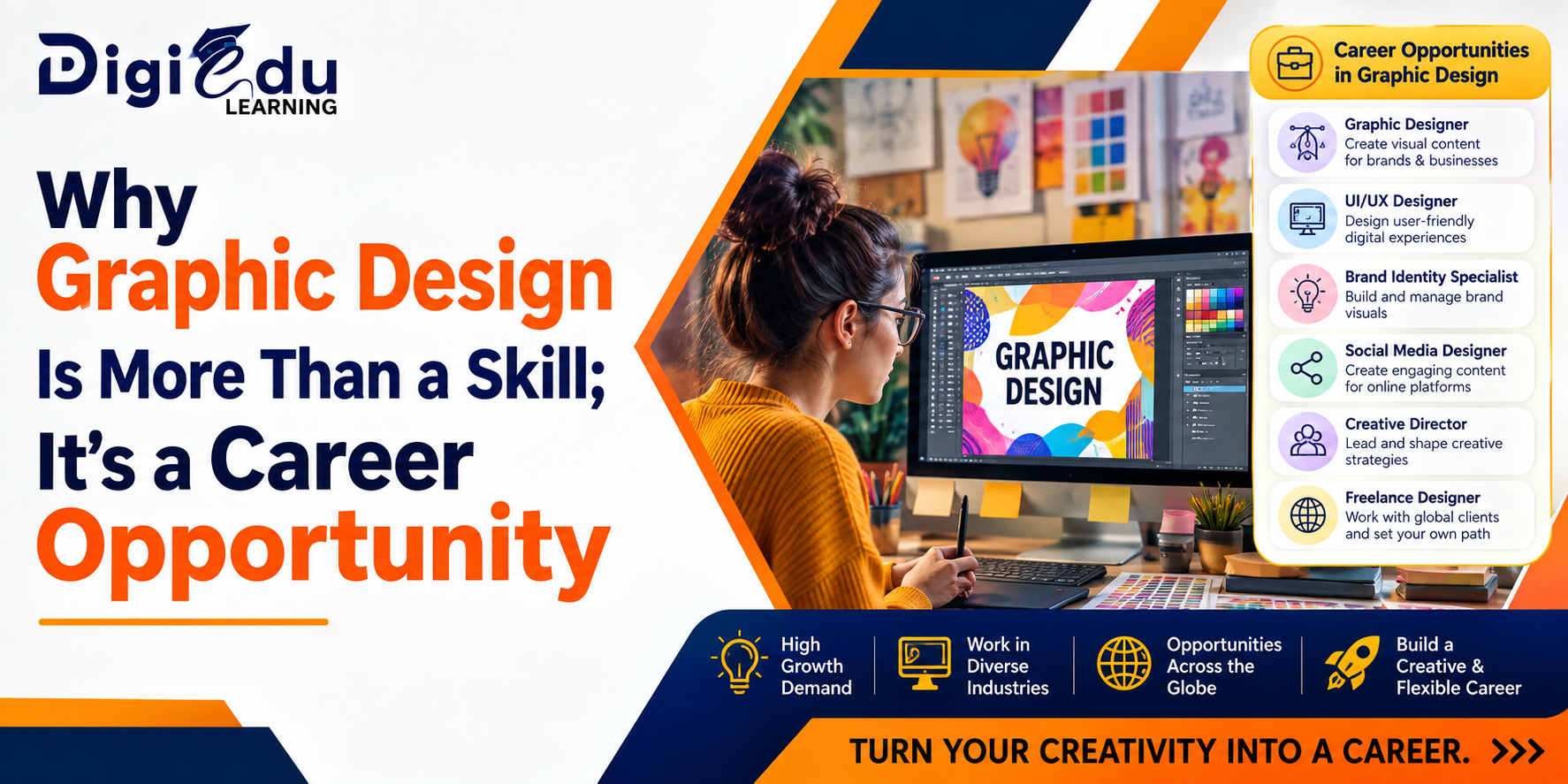
For someone thinking about a career that means graphic design is more than just a technical skill. It can be a job path with chances in agencies, brands, startups, media companies, online businesses, and as a freelancer.
Industry Insight
Why Is Graphic Design Becoming More Important for Digital Brands?
Every digital interaction is becoming more and more visual. A customer might find a business because of an Instagram post. They could see an ad on a website. They might watch a branded video. They could get an email. They might go to a landing page.
In every one of these situations, design plays a role in how fast the message is understood and how professional the brand seems.
That is why companies are looking for people who can do more than just use design software. They need people who know about communication. They need people who know about brand consistency. They need people who know about formats. They need people who understand audience behaviour.
The growth of AI tools has also changed the industry. AI can help create ideas, different versions, and visual concepts. It does not take away the need for designers who understand composition. They need to understand hierarchy. They need to know about typography. They need to know about branding. They need to know about communication.
In fact, the skill to mix creative thinking with new technology can be a big advantage.
What Does a Professional Graphic Designer Actually Do?
A professional graphic designer solves communication problems visually.
Suppose a new business wants to launch a product. A designer may be involved in creating the logo, social media campaign, promotional creatives, presentation, website banners, and other brand assets.
The job is not simply to make each item look good. The visuals need to communicate the right message to the right audience while maintaining consistency.
A designer therefore needs to understand questions such as:
- Who is the target audience?
- What should the viewer notice first?
- What emotion should the design create?
- Which colours and typography support the brand?
- Where will the design appear?
- What action should the viewer take?
These decisions separate professional design work from template-based content creation.
Expert Commentary
Which Skills Should Students Learn for a Graphic Design Career?
A strong graphic design education should combine creative thinking with practical execution.
Students should learn the fundamentals of composition, colour theory, typography, visual hierarchy, and branding before becoming overly dependent on templates or ready-made layouts.
Software proficiency is equally important, but it should support creative thinking rather than replace it. A designer who knows the tools but cannot develop an effective visual concept will eventually struggle when working with real clients.
Portfolio development is another important part of career preparation. Employers and clients often want to see what a designer can actually create rather than only knowing which software they have studied.
A practical learning approach should therefore give students opportunities to work on different design requirements, receive feedback and improve their work.
For students looking for structured training, choosing a Graphic Designing Institute in Delhi can be useful when the programme focuses on practical assignments, portfolio development and industry-relevant skills rather than software demonstrations alone.
Proof & Real-World Perspective
Where Can Graphic Design Skills Be Used?
Graphic design is connected to far more industries than many beginners initially realise.
Consider an e-commerce company launching a new collection. It may need product banners, social media creatives, promotional advertisements and website graphics.
A restaurant may require menus, promotional posts, packaging and festival campaigns.
A startup may need a complete visual identity, pitch-deck design, website assets and marketing material.
A digital marketing agency may need designers who can produce creatives for multiple clients and platforms.
The same core design knowledge can therefore be applied across very different business environments.
This flexibility is one reason graphic design can appeal to students who want a creative career without restricting themselves to a single industry.
Graphic Design Career vs Learning Only Design Software
There is an important distinction between knowing a tool and being a designer.
Someone may know how to crop images, remove backgrounds, create layouts, and apply effects. But professional work often requires interpreting a client’s brief, developing concepts, responding to feedback, and creating designs that support a business objective.
| Learning Only Software | Building a Design Career |
| Focuses mainly on tools | Combines tools with creative thinking |
| Relies heavily on templates | Develops original concepts |
| Creates individual designs | Understands complete brand communication |
| Limited practical exposure | Builds projects and portfolio work |
| Technical knowledge | Technical + strategic design ability |
The difference becomes particularly visible when a designer starts working with real clients.
Analysis
Is Graphic Design a Good Career Choice in the Age of AI?
AI is changing how creative work is produced, but it does not make design knowledge irrelevant.
Instead, the nature of the designer’s role is evolving.
AI can help with brainstorming, generating variations, exploring concepts, and speeding up repetitive tasks. However, someone still needs to determine whether a visual is appropriate for the brand, whether the hierarchy works, whether the message is clear, and whether the final design communicates effectively.
This means future designers may need a combination of three capabilities: creative judgement, technical design skills, and AI literacy.
The strongest professionals are likely to be those who use technology to increase their productivity while retaining control over the creative decision-making process.
What Mistakes Should Beginners Avoid?
One common mistake is focusing entirely on software shortcuts while ignoring design fundamentals.
Another is creating dozens of unrelated designs without developing a coherent portfolio. A smaller collection of thoughtful projects can communicate professional ability more effectively than a large collection of repetitive social media posts.
Beginners should also avoid copying trends without understanding why a particular design works. Trends change quickly; fundamental design principles remain useful much longer.
Most importantly, students should practise solving different types of visual communication problems rather than creating only the designs they personally enjoy.
Recommendations
How Should You Prepare for a Career in Graphic Design?
Start by building a foundation in design principles. Understand typography, colour, spacing, composition, contrast, and visual hierarchy.
Then develop proficiency in relevant design tools and apply those skills through practical projects.
Your portfolio should demonstrate variety. Include projects that show branding, social media design, advertising creatives, presentations, digital graphics, or other areas that match the kind of work you want to pursue.
It is also useful to develop the ability to receive criticism. Professional design is collaborative. Clients, marketing teams, and creative directors may request changes, and responding constructively is part of the job.
Finally, stay familiar with emerging technologies. AI-assisted design is becoming part of modern creative workflows, so learning how to use these tools responsibly can complement traditional design expertise.
For students considering formal training, a Graphic Designing Institute in Delhi should be evaluated on practical exposure, trainer experience, portfolio opportunities, curriculum relevance, and the extent to which students actually create work during the programme.
The goal should not simply be to complete a course. It should be to leave with skills that can be demonstrated.
Closing Thoughts
Graphic design has moved well beyond posters, logos and basic social media creatives. It now plays a central role in how businesses communicate across digital platforms, which creates opportunities for people who can combine creativity with practical business understanding.
For aspiring designers, the smartest approach is to develop fundamentals first, become confident with professional tools, build a meaningful portfolio, and learn how modern technologies such as AI can support the creative process.
Choosing the right Graphic Designing Institute in Delhi can make that learning journey more structured, particularly when training focuses on practical work rather than theory alone.
At Digi Edu Learning, the focus is on developing practical, industry-relevant digital skills that students and professionals can apply beyond the classroom. With the right training, consistent practice, and a portfolio that demonstrates real capability, graphic design can become not just something you know—but a skill you can build a career around.
Popular News



Our Partners