



What is Performance Marketing? How It’s Different from Digital Marketing
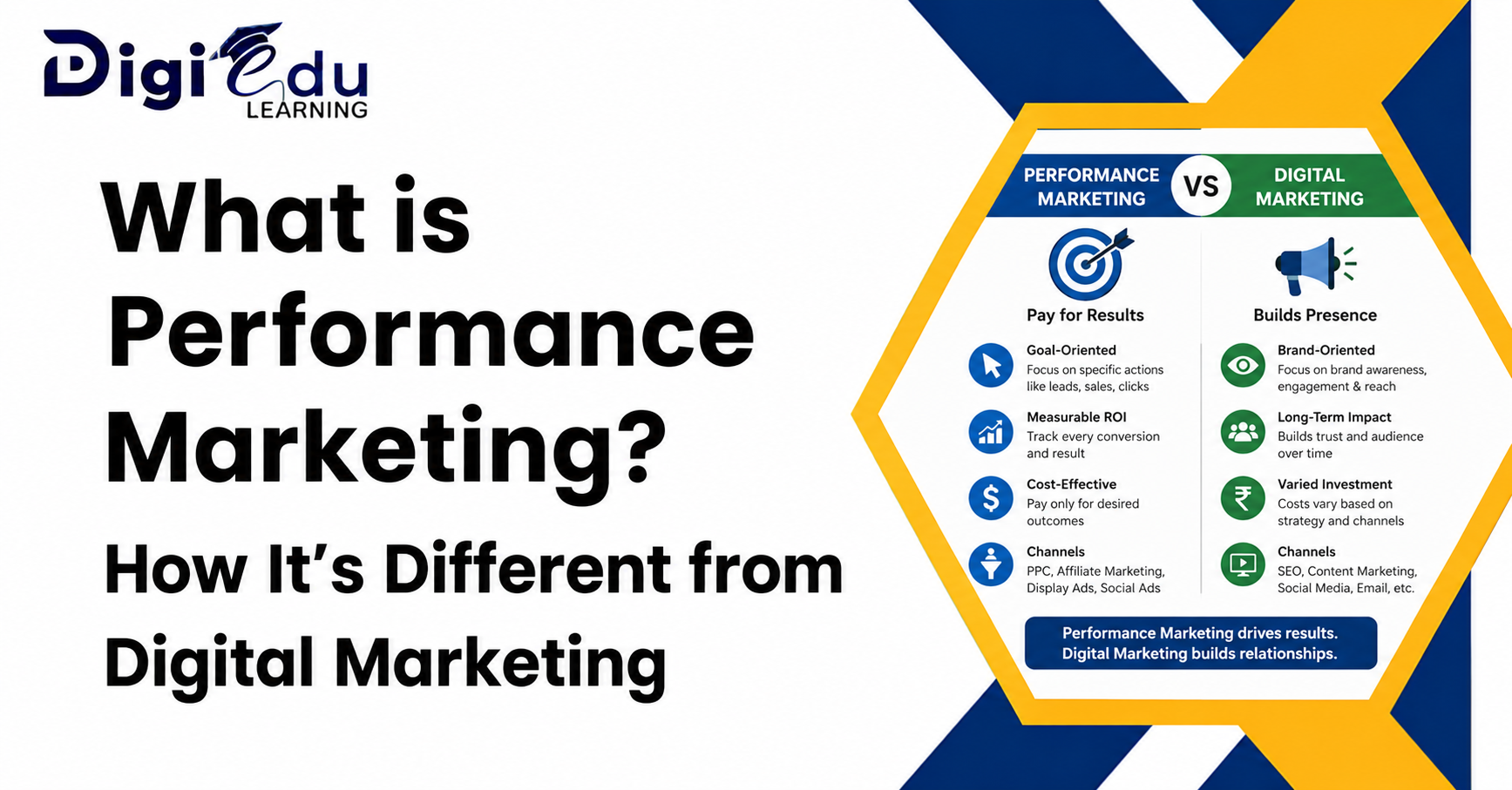
As we know, the internet is an extremely competitive place, and companies often look for ways to give them something concrete. Performance marketing is one of those tools that has gained popularity over time. In contrast to the conventional model of marketing that is based upon visibility and reach, Performance Marketing is about certain actions.
Due to the need for accountability and quantifiable ROI on investments, and the increase in complexity in the corporate world, performance marketing is increasingly favored by companies regardless of size. Performance marketing is common in digital marketing, although it does not mean digital marketing.
Understanding the Basics of Performance-Based Advertising
Before understanding performance marketing, it is necessary to become familiar with its nature and distinguish it from the conventional methods of advertising.
What is performance marketing?
Performance marketing is one type of online advertising in which payment is only made for a specific action. Actions might be clicks, app installations, purchases, form fills, or leads.
This campaign-driven approach guarantees advertising dollars are utilized effectively, and advertisers are able to measure the effectiveness of the advertising campaign accurately.
Common activities that enterprises buy:
- Website clicks
- Product purchases
- Lead generation
- Mobile app downloads
- Newsletter sign-ups
Why Businesses Prefer This Model
Transparency is one of the greatest benefits of performance marketing. Brands can track campaign performance in real-time and fine-tune campaigns for better results.
Major benefits include the following:
- The value added increases due to better return on investment.
- Measurable campaign results
- Improved targeting capabilities
- Flexible budget management
How Digital Marketing and Performance Marketing Differ
While both strategies are internet-based, there are distinct differences between digital marketing and performance marketing.
Broader Scope of Digital Marketing
All online marketing activities used to promote a brand, product, or service are part of digital marketing. It is all about awareness, engagement, and relationship building with customers.
These are the digital marketing channels:
- Search engine optimization (SEO)
- Social media marketing
- Content marketing
- Email campaigns
- Online public relations
Results-Focused Nature of Performance Marketing
Performance marketing is different from traditional digital marketing because it is focused on quantifiable results. One is no longer just thinking of making things visible but of reaching certain business objectives.
Key distinctions include the following:
- Based upon results, the payment is made.
- Conversions were well-focused.
- Real-time tracking and analytics:
- Data-driven campaign optimization
Popular Channels Used in Performance Marketing
There are a variety of online platforms and advertising channels that can be used for a performance marketing campaign. Choices of channels depend on the business objectives, the individuals they need to reach, and the amount of money they have.
Search Engine Advertising
One of the most successful forms of performance marketing is paid search ads, which are targeted towards people looking to purchase a product or service.
The advantages of search ads are:
- High-intent audience targeting
- Immediate visibility
- Flexible bidding strategies
- Easy performance measurement
Social Media Advertising
Brands can target their social media audiences by demographics, interests, and behavior. This results in very personalized and effective campaigns.
These are some of the most common social media sites:
- YouTube
- TikTok
Key Metrics That Define Success
Performance marketing campaigns will work if the right metrics are analyzed. This information enables you to make efforts that are designed in a way that ensures you generate profits.
Conversion Rate and Cost Per Acquisition
A conversion rate is defined as the number of users that take the desired action, and the cost per acquisition is the amount of money it takes to acquire a customer.
Important metrics include:
- Click-through rate
- Cost per click
- Return on ad spend
- Customer acquisition cost
Data-Driven Decision Making
One of the best advantages associated with performance marketing includes the option to make decisions using real-time data. It can be fairly easy to figure out what works and what does not in your marketing campaigns.
Data analysis has several benefits:
- Better campaign optimization
- Improved audience targeting
- Higher conversion rates
- Reduced advertising waste
Potential Business Issues
Performance marketing is excellent, but there are also some hurdles involved in this method, and it is crucial for organizations to understand these hurdles before fully embracing it.
The idea of performance marketing campaigns.
Rising Advertising Costs
With the rise in competition on digital platforms, ad rates may get very high, particularly in competitive businesses.
Common cost-related challenges:
- Increased bidding competition
- Increased customer acquisition costs (CAC)
- Financial constraints for small enterprises.
- Defining ad fatigue among users.
Dependence on Data and Technology
Analytics tools, tracking tools, and automation tools are essential parts of any performance-based campaign. Changes in algorithms and privacy laws may affect your campaign’s success.
Potential challenges include the following:
- Limitations on privacy and tracking
- Constant platform updates
- Requires technical skills.
- Difficulty in campaign management.
Why Businesses Should Combine Both Strategies
Some brands prefer a blend of these two strategies over selecting one over another, and for good reason. Rather, many brands prefer to use a mix of digital marketing and performance marketing to ensure their maximum effect. This establishes a sound approach that will promote both brand awareness and growth in measurable terms.
Creating Long-Term Brand Value
Digital marketing can be used to build trust and nurture long-term customer relationships. This base enables performance campaigns to be effective.
Long-term benefits include:
- Stronger brand recognition
- Better customer trust
- Consistent audience engagement
- Improved market positioning
Achieving Faster Results
Meanwhile, performance marketing allows businesses to generate immediate leads and sales, along with measurable results. Mixing both strategies will yield a better marketing ecosystem.
Advantages of integration:
- Short- and long-term growth in balance.
- Improved conversion opportunities
- Better marketing efficiency
- Enhanced customer journey
Conclusion
With businesses competing in the digital world, it is imperative that they know what performance marketing is. Performance marketing campaigns are based on measurable actions and actual business results as opposed to the more awareness and engagement-centric digital marketing strategies.Digital marketing and performance marketing are both crucial parts of a successful marketing campaign. One helps to establish the long-term brand authority; the other provides “fast” and measurable results. Aspiring marketers and business owners can learn more about these changing trends and implement them in a way that can help them see sustainable business growth through educational platforms such as Digi Edu Learning.
One response to “What is Performance Marketing? How It’s Different from Digital Marketing”
Leave a Reply
Popular News



Our Partners





This is basically a luxury casino experience from the comfort of my home. The game selection is massive and everything is high quality. nustargameonlinecasino is simply the best.