
How the Best Performance Marketing Course Builds Skills Beyond Ad Management
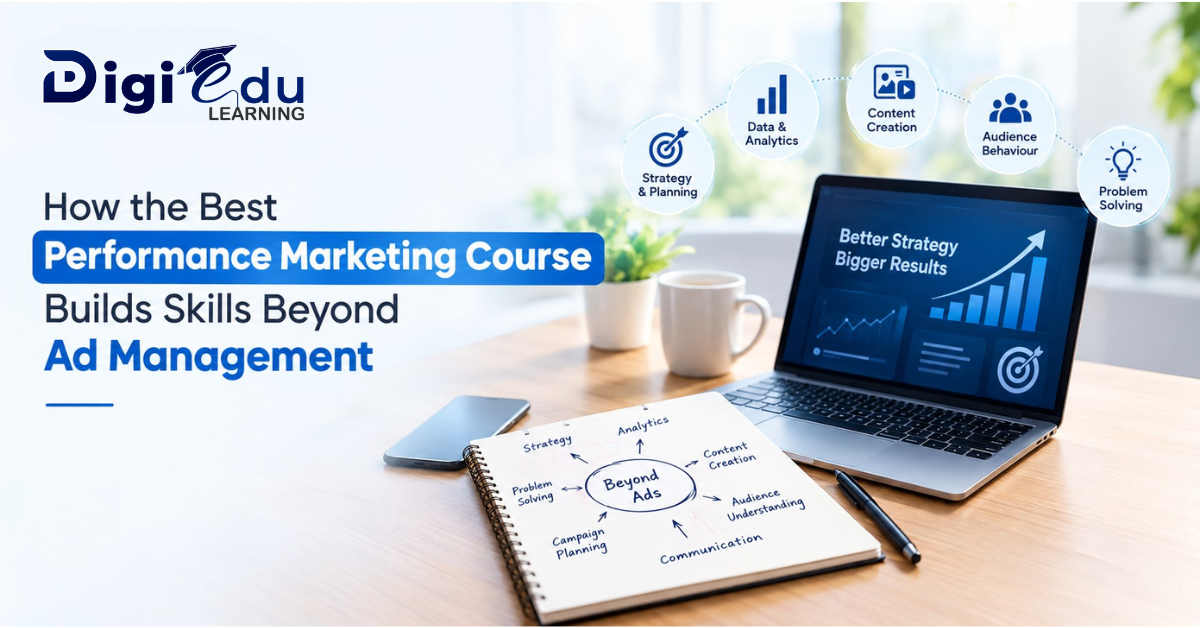
Performance marketing is always associated with advertising, budgeting, and tracking conversions. However, professional digital marketing entails a lot more than just being able to launch a campaign. It involves being knowledgeable about one’s audience, analysing data, crafting effective messaging, and optimizing landing pages.
Those who wish to make a practical career for themselves in this field by taking the Best Performance Marketing Course in Faridabad could benefit from building up such skills. For that matter, a good course would ensure that, besides teaching students how the advertising platforms operate, it will help them understand how the various digital marketing aspects relate to business goals. For any marketers who aspire to learn, Digi Edu Learning can be seen as an option to learn about performance marketing as well as other digital skills.
What Does Performance Marketing Involve Beyond Ad Management?
Management of ads is just one aspect of performance marketing. Even a marketing campaign that has a definite budget and accurate targeting might still fail to generate the desired results. The following should be understood by a performance marketer as well:
- Target audience
- What motivates customers to act
- Marketing channel for a specific purpose
- Creating relevant ad copy
- The impact of landing pages on conversions
- How to analyze campaign data
- How to detect ineffective expenditure
- Testing out various creative and messaging options
- Marketing role in business objectives
The broader perspective makes it easier for students to go beyond using advertising systems to become digital marketers.
Best Performance Marketing Course in Faridabad: Building a Broader Skill Set
An effective course would ensure that students get acquainted with various competencies that enable success in digital marketing campaigns. Rather than being limited to dashboards of ads only, students should know the full customer journey.
1. Audience Research and Customer Understanding
Before designing an advertisement, it is important for the marketer to understand who their target audience is. Through audience research, they can understand the needs of the customers, their problems, motivations for buying, interests, and objections.
In another example, when developing an advertisement to market a professional training course to a college student, the message will be different from that used to market the same product to a person who is already a marketer.
2. Copywriting and Creative Strategy
The performance marketer must be able to convey the value proposition effectively. A good advertisement should immediately tell why one would need to pay attention and what action he or she could undertake. The creative concept is not about picking a good-looking picture but rather about understanding the right message, format, offer, or visuals to use. Copywriting techniques learned by students can be used in:
- Paid search
- Social network marketing
- Landing pages
- Email marketing
- Promotional content
- Social media posts
This is why copywriting is not only a skill for handling advertisements.
3. Landing Page and Conversion Understanding
Making someone click the advertisement is not the ultimate goal. What comes next could very well affect how well the campaign performs. The following are some fundamentals of conversion that a marketer must know:
- Good headlines
- Relevant messages
- Effective calls to action
- User-friendly navigation
- Trust-building information
- Mobile-friendly format
- Consistency in Ads & Landing Pages
This helps students analyze the performance of a marketing campaign from a different perspective. They do not need to assume that the advertisement alone is the cause but will also think about the post-click landing page.
Data Analysis and Performance Measurement
One of the key aspects in which performance marketing is different from traditional advertising is that the latter pays more attention to having measurable statistics. It is important for students to learn how to analyze data and what it implies. Depending on the purpose of the marketing campaign, it can include impressions, clicks, CTR, CPC, conversions, CPA, and ROI, but that is not enough. An efficient marketer has to be able to ask the right questions like:
- Why was there high click-through, but low conversion?
- Which audience group is more responsive?
- Which ad is getting more attention?
- Is the campaign budget being spent wisely?
- What should be tested next?
- Does the problem lie in the targeting, the ad, the offer, or the conversion process?
This process of analysis will help to make decisions from campaign data.
Testing and Optimisation Skills
Performance marketing is not always just a one-time process of implementation. Sometimes campaigns need ongoing monitoring and improvement. A student needs to know the fundamentals of testing different factors, for example:
- Advertising headings
- Main content
- Pictures or video clips
- CTA
- Targeted audience
- Landing page content
- Campaign setup
Testing is not for making random modifications. Testing is done to obtain important information and make use of that information in order to make better decisions in the future. This is when the real value of learning practically comes into play. Students will be able to know the reason for the modification and observe its impact.
Understanding Different Digital Marketing Channels
It is also useful to understand how various marketing channels can be coordinated. For example, one company could use the channel of search advertising to attract users actively searching for the particular product or service offered, while another company would use social advertising to reach them at an earlier stage of decision-making. The following channels can also be helpful:
- Optimising for search engines
- Marketing on social media
- Content marketing
- Email marketing
- Website optimisation
- Search advertising
- Social media advertising
Knowledge about these marketing channels will help marketers avoid assuming that all business issues can be solved by way of advertising. The business may not necessarily need increased spending on advertisements but may require more visibility, content, or even website changes.
Business and Marketing Strategy
The marketer needs to know what the business goal is in relation to the campaign as well. An advertisement strategy that might work for one business does not always fit another one. There might be differences between a service company, an e-commerce firm, an education business, and a B2B enterprise. Students need to understand how marketing activities can be related to:
- Lead Generation
- Sales
- Branding
- Traffic
- Engagement
- Appointment Scheduling
- Customer Acquisition
This wider scope will allow students to gain insights into the reason behind creating a campaign instead of limiting their understanding to setting up one.
Communication and Client Management Skills
Communication skills are important for professional marketers too. The marketer might have to communicate about the performance of the marketing campaign to the business owner or provide a report on the same. This implies that the learners should develop skills in:
- Marketing metrics explained in simple language
- Campaign insights expressed in clear terms
- Results linked to business goals
- Recommendations communicated
- Understanding the client’s needs
- Campaign decisions documented
This knowledge may prove very useful when dealing with clients, agencies, startups, or even in-house marketing departments.
How to Choose the Right Course for Your Career Goals
Everyone has different goals for learning. While some students may aim to pursue a career in digital marketing, others may be looking to include performance marketing in their current roles or client-based work. Before choosing your course, you should ask yourself whether the course gives you access to:
| Skill Area | Why It Matters |
| Advertising platforms | Helps learners understand campaign execution |
| Analytics | Supports data-based decision-making |
| Copywriting | Improves communication and ad messaging |
| Audience research | Helps create relevant campaigns |
| Conversion optimisation | Connects traffic with business outcomes |
| Testing | Encourages structured campaign improvement |
| Digital strategy | Builds broader marketing understanding |
| Practical projects | Helps apply concepts to realistic situations |
Analyzing the curriculum from this angle may help students determine whether the class is just covering platform usage or helping them to develop their overall marketing skills.
Building Skills That Remain Useful Beyond One Platform
The way advertising platforms interface, features, targeting capabilities, and campaigns work evolves with time. As such, understanding where to click at a specific dashboard can prove insufficient in terms of long-term gains.
Basic skills like audience analysis, persuasion, analysis, testing, conversion mindset, and marketing strategy can be used across various platforms. This is the reason why performance marketing education must primarily concentrate on principles, along with platforms.
Conclusion
Performance marketing is far more than just designing ads and managing budgets. The performance marketer has a wide range of skills such as knowing their audience, creativity, analysis, conversion optimization, testing, communication, and business planning. For students considering the Best Performance Marketing Course in Faridabad, the important thing to keep in mind is not to focus only on the advertising tool itself.
The Digi Edu Learning approach can be considered by those students who would like to develop their knowledge of performance marketing as well as acquire skills that will go beyond mere advertising management. The correct learning path for the student will lead to gaining an understanding of how to analyze and optimize marketing efforts as well as align them with business objectives.
Frequently Asked Questions
1. What skills should be taught in a performance marketing class?
The class must include skills in advertising, audience research, copywriting, analytics, conversion optimization, campaign testing, and digital marketing strategies.
2. Does performance marketing revolve only around placing paid advertisements?
Performance marketing includes paid advertising as one of its main components, but apart from that, it includes data analysis, customer research, strategic thinking, landing page optimization, and measurement of business outcomes.
3. Why is analytics important in performance marketing?
It enables marketers to analyze their performance, improve where required, compare outcomes, and make decisions based on the existing data.
4. Is performance marketing suitable for beginners?
Yes. Beginners can learn performance marketing from the basics and move forward to develop their skills in campaign creation, advertising tools, analytics, and optimisation.
5. What factors should I take into account while selecting a performance marketing course?
Course content, practicality of learning, analytics and optimisation, marketing strategy, and how well the training fits into your career/business needs are all factors you should take into account.
Popular News



Our Partners