
How Should Beginners Build a Learning Path From SEO and Social Media Marketing to Performance Marketing
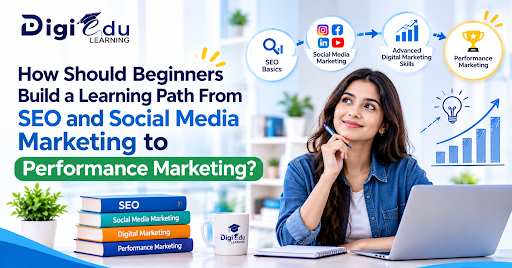
The process of choosing a career path in digital marketing can be intimidating due to the number of skills, platforms, and career paths one needs to consider. For starters, one tends to be confused about whether they should take up search engine optimization, social media marketing, pay-per-click, or analytics. It is better for one to acquire these skills in a systematic manner as opposed to trying to cover everything at once. One can begin by taking up SEO Training in Faridabad to learn more about how websites are driven by organic traffic.
Digi Edu Learning enables students to appreciate the significance of gaining digital marketing skills that integrate various platforms and prepare them for more complex marketing roles.
1. Start With the Fundamentals of Digital Marketing
It is necessary to know about the operation of the digital marketing system before one selects any specialization. Any action that takes place during the process of online marketing has a specific purpose that is being achieved – brand promotion, website traffic, leads, or sales. First of all, one must get acquainted with the very fundamentals of online marketing such as target audience, user experience, marketing channels, and conversion.
For instance, a company that deals with skin care can use search engines to reach out to potential clients who need help with skin care issues, social media to give information about their product, and advertising to give offers. While all these channels operate in different ways, they share one goal. The fundamentals of marketing terminology must also be known by beginners. Some of the fundamentals are impressions, clicks, reach, engagement, traffic, leads, conversion, and ROI.
2. Learn SEO Before Moving Towards Advanced Marketing
It will be helpful to start with Search Engine Optimization since it helps newbies understand how people find information on the internet. Search Engine Optimization is the practice of making your website more visible in organic search results through improved content and technical features.
A well-organized SEO training in Faridabad must acquaint students with the different aspects of SEO and their interaction.
Beginners should focus on the following skills:
- Keyword Research: Learn the methods of discovering keywords according to the intent of the users and business goals.
- On-Page SEO: Learn the methods of optimizing title tags, meta descriptions, headings, URLs, images, and website content.
- Technical SEO: Learn the methods of crawling and indexing websites, increasing page speed and mobile-friendliness of the websites, and solving technical issues.
- Off-Page SEO: Learn the methods of building backlinks and link-building techniques.
- Content Optimization: Learn the methods of creating helpful and relevant content to answer user queries.
Practice is just as important. A beginner can practice doing keyword research, creating an outline of content, checking website pages, and detecting technical errors. Another skill that needs to be developed is that of search intent. For instance, when someone searches for information regarding digital marketing, it is unlikely that they are ready to buy the course. However, when someone searches for a digital marketing training institute, they are probably ready to buy.
3. Develop Audience Engagement Skills Through Social Media Marketing
Now that the learners know how they can attract visitors to their websites by means of search engines, it is time for them to know how companies can reach out to their audiences through social media networking. This will include content creation and distribution, community management, and brand building through social media. Social media marketing aids in understanding the audience’s needs. Taking a Social Media Marketing Course in Faridabad can help newcomers gain practical knowledge about handling various social media platforms.
Important areas to learn include:
- Content Planning: Developing content schedules that tie into business goals and audience preferences.
- Platform Knowledge: Having an understanding of use cases of Instagram, Facebook, LinkedIn, etc. for different audiences.
- Content Creation: Having an understanding of captioning, graphics, short video content, etc.
- Community Management: Responding to questions from the audience in a professional manner.
- Performance Analysis: Analysis of reach, impressions, engagement, profile views, and other metrics.
The new user must be taught on how to make posts’ examples, captions, weekly content creation, and how to evaluate performance of various types of contents. For example, a local educational institution may decide to use Instagram for posting videos of its courses, LinkedIn for professional content creation, and Facebook for making connections with the community. Every social media platform has its own way of creating content. This will make the new learner go beyond mere content creation. They will start realizing why some kind of message works on one platform but doesn’t work on the other.
4. Connect SEO and Social Media Marketing With Business Goals
While learning about SEO and social media individually is helpful, it is when you learn about the collaboration of the two that a digital marketer becomes efficient. SEO ensures that the business attracts users who are in search of relevant information, while social media will help you reach out to them via the content provided. If both these channels adopt a strategy in unison, the business will be able to communicate consistently on both these platforms. For example, let us consider a business that provides professional courses online. The SEO strategy will incorporate blogs and course-specific landing pages.
A customer could come across the company through a social media post and later check out its website through a Google search. A different customer could come across a blog through organic search and follow the social media handles of the company before making an enquiry. Beginners need to start learning how to connect these:
- Uniform messaging across various channels.
- Content that is relevant to the issues faced by the audience.
- Landing pages with valuable information.
- Internal linking directing website visitors to valuable web pages.
- Performance analytics for better traffic and performance insight.
At this point, students gain insight into the entire customer journey and prepare for learning about paid marketing.
5. Move Towards Paid Advertising and Campaign Management
Once the beginner understands the basics of SEO and social media marketing, they can begin to learn paid advertising. Here, they will be a step closer to performance marketing. Unlike organic marketing, paid advertising means that you spend money to advertise your product or service to a certain audience. Companies use paid marketing campaigns to drive website traffic, create leads, sell products, and many more. The beginner needs to differentiate between search advertising and social media advertising.
| Advertising Channel | What Beginners Should Learn |
| Google Search Ads | Keyword targeting, search intent, ad copy, and bidding |
| Display Advertising | Audience targeting, visual advertisements, and placements |
| Meta Ads | Campaign objectives, audience selection, creatives, and budget allocation |
| YouTube Ads | Video advertising, audience targeting, and campaign formats |
| Remarketing | Reaching people who have previously interacted with a website or brand |
Start with the basics of the campaign structure and become familiar with the structure of campaigns, ad groups, ads, and the types of targeting. Newbies need to learn how to make relevant ads, select landing pages, and understand the relationship between ad budget and campaign objectives. It is necessary not to begin spending money without knowing campaign settings. Training by means of sample campaign setups will allow the learner to get acquainted with the platform of advertising beforehand.
6. Build Advanced Skills Through Performance Marketing Training
This is because in performance marketing, it is all about achieving tangible accomplishments through internet marketing. In performance marketing, you will be required to find out if the marketing campaign has been able to achieve any tangible activity, such as lead generation, signups, sales, and conversions. This is where you, as a student, will be required to master the skills of advertising, analytics, and optimization.
Best Performance Marketing Training in Faridabad should cover important concepts such as campaign planning, audience targeting, conversion tracking, budget management, and performance analysis.
Some essential skills include:
- Conversion tracking: Know how to gauge what your visitors are doing.
- Optimisation of campaigns: Know how you can optimise a campaign.
- Analytics: Know how to analyse your data from the website and ads.
- Budgeting: Be knowledgeable in allocating your budget among various campaigns, as well as being aware of your budget spent versus the output produced.
- A/B Testing: Be knowledgeable in experimenting with different ads, titles, creatives, and landing pages.
Analytical skills are also useful for performance marketing. There may be plenty of clicks in the marketing campaign, but there will be few leads. In this case, rather than assuming that high traffic equals high performance, it is necessary to conduct an analysis of the audience, the advertisement, the landing page, and the conversion process.
7. Follow a Practical Learning Roadmap
The structured nature of the process makes things simpler for the beginner. There is no need to shift from one tool to another. The recommended approach is as follows:
| Learning Stage | Skills to Develop | Practical Activity |
| Stage 1 | Digital marketing fundamentals | Understand customer journeys and marketing channels |
| Stage 2 | SEO | Perform keyword research and optimise sample website pages |
| Stage 3 | Social media marketing | Create content calendars and sample social media posts |
| Stage 4 | Paid advertising | Prepare sample Google and Meta ad campaigns |
| Stage 5 | Performance marketing | Study conversion tracking and campaign optimisation |
| Stage 6 | Analytics and reporting | Prepare reports and evaluate campaign performance |
The amount of time needed for each step will vary depending on the individual’s prior knowledge, practice plan, and conceptual comprehension. The beginner will have to ensure that he/she does not build a large portfolio but also one that can teach him/her something. This may include sheets on keyword research, SEO audit, content calendar, sample ads, campaigns, and performance reports.
8. Choose Training That Focuses on Practical Learning
Choosing a proper training program is one of the significant steps for starters. A good training program must do more than just define things and illustrate them, but must ensure that learners learn how to use them. In the course selection stage, be sure that the program you choose will introduce learners to basic and advanced topics in digital marketing. Learners must be able to move from SEO and social media marketing to paid marketing and performance analysis.
- Course Curriculum Structure: Make sure that the subjects are structured in such a way that makes learning effective.
- Practice Opportunities: Make sure that the learners have opportunities to practice keyword research, content creation, and campaigns.
- Knowledge about the Tools: Make sure you know the tools used in SEO, advertising, and analytics.
- Real-life Business Examples: Real-life business examples would be helpful to understand some tough concepts of marketing.
- Help for Beginners: Learners may be helped in overcoming any difficulties faced by them while practicing.
- Learners’ Portfolio Creation: Check if the learners have chances to build up portfolios for themselves.
Avoid choosing a course that teaches many tools. Knowing when and how to use a tool is better than learning about its capabilities.
Conclusion
It gets simpler for beginners to build their careers in digital marketing by following a step-by-step process of learning. Learning SEO will help beginners learn about organic search, while taking a Social Media Marketing Course in Faridabad will help them learn about audience engagement, content creation, and communication. All these skills will form the base for learning paid advertising, campaign management, analytics, and conversion optimization. The best way is to learn the theory as well as practice regularly.
The Digi Edu Learning can be considered by students looking for a course in digital marketing education in Faridabad. It would definitely help beginners in preparing themselves for the demands of digital marketing.
Frequently Asked Questions
1. Is it possible to start learning digital marketing without prior experience in it?
Yes. Beginners can start with the fundamentals of digital marketing and proceed to SEO, social media marketing, PPC marketing, and analysis. No advanced technical knowledge is required for learning the fundamentals.
2. Which channel should I learn first – SEO or social media marketing?
Both of them will suit as an entry point well. SEO will teach about organic visibility, whereas social media marketing will teach creating content and engaging the audience. Maybe it will be beneficial to learn SEO first and then proceed to other channels.
3. What is the next stage of my study after mastering SEO and social media marketing?
After getting the basic knowledge of SEO and social media marketing, the next step for beginners can be learning Google Ads, Meta Ads, campaign management, conversion tracking, and analysis.
4. Can performance marketing be considered by freshers?
Yes. Freshers can opt for performance marketing once they have gained knowledge about the basics of digital marketing. This will help them to prepare themselves for entry-level positions.
5. What should be the practical projects for beginners in the digital marketing portfolio?
Some practical projects that beginners can take up in their digital marketing portfolio include keyword research reports, SEO audits, social media calendars, advertising campaign plans, landing page ideas, and performance reports.
Popular News

Our Partners