



Top 100 Digital Marketing Interview Questions In 2026
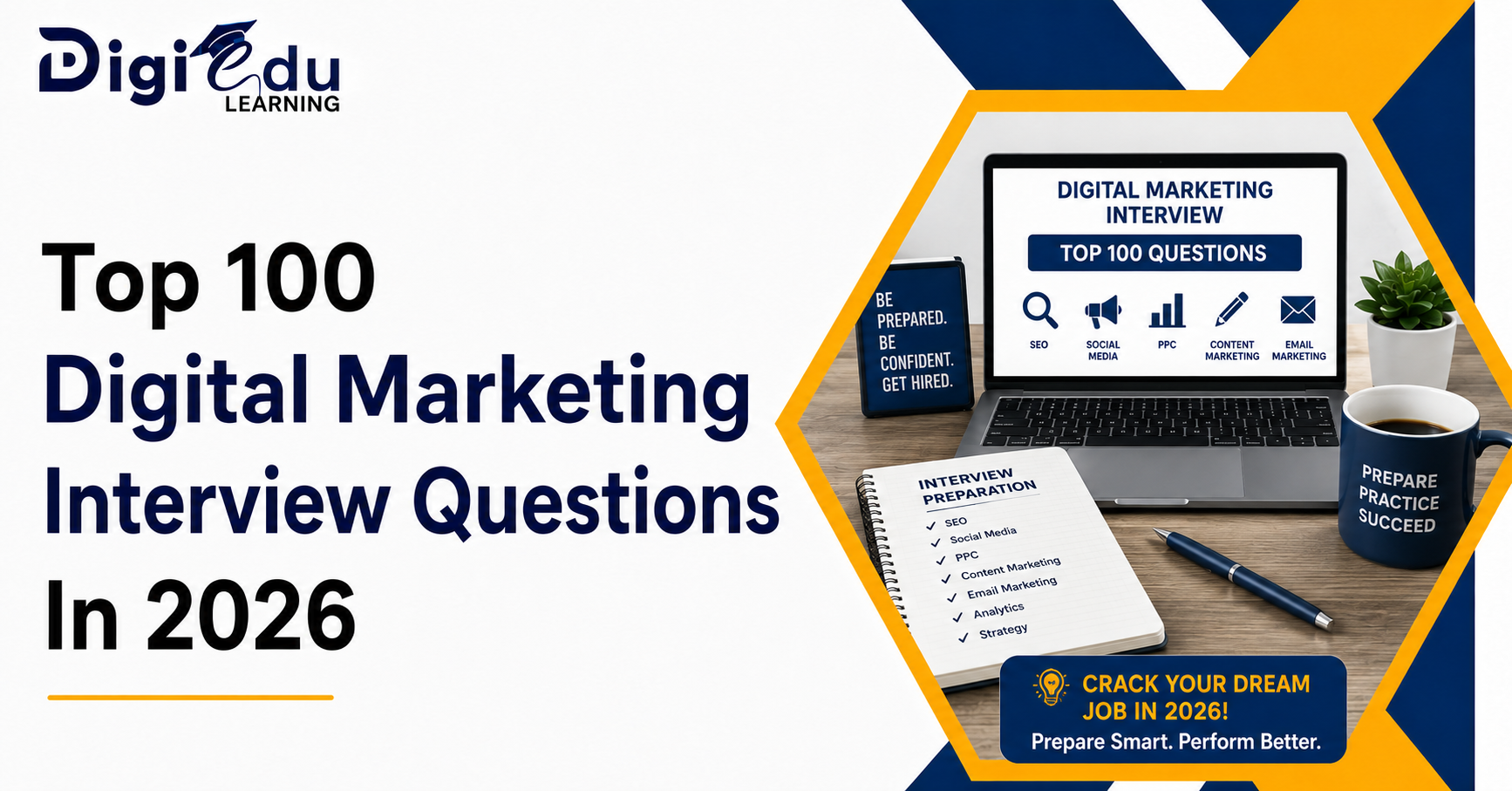
Landing a digital marketing interview has become easier than clearing one. Recruiters today expect candidates to understand not only SEO and Google Ads but also AI-powered marketing, automation, analytics, and customer behavior.
Whether you’re a fresher looking for your first job or an experienced marketer aiming for a better opportunity, preparing the right Digital Marketing Interview Questions can significantly improve your confidence. This guide covers the top 100 questions that companies are asking in 2026, along with concise, interview-ready answers.
1. What is Digital Marketing?
Answer:
Digital marketing is the promotion of products or services using online channels such as search engines, social media, websites, email, mobile apps, and paid advertising. Unlike traditional marketing, digital marketing allows businesses to target specific audiences, measure campaign performance, and optimize strategies based on real-time data.
2. What are the major types of Digital Marketing?
Answer:
The major types include Search Engine Optimization (SEO), Search Engine Marketing (SEM), Pay-Per-Click (PPC), Social Media Marketing (SMM), Content Marketing, Email Marketing, Affiliate Marketing, Influencer Marketing, Video Marketing, Mobile Marketing, and Performance Marketing.
3. What is the difference between Traditional Marketing and Digital Marketing?
Answer:
Traditional marketing uses offline channels such as newspapers, television, radio, and billboards, while digital marketing relies on online platforms. Digital marketing offers better targeting, measurable results, real-time optimization, and generally provides a higher return on investment.
4. Why is Digital Marketing important?
Answer:
Digital marketing helps businesses reach their target audience more efficiently, generate qualified leads, build brand awareness, increase website traffic, and improve sales. It also provides measurable insights that help businesses make data-driven marketing decisions.
5. What is a Marketing Funnel?
Answer:
A marketing funnel represents the customer journey from discovering a brand to making a purchase. The common stages are Awareness, Interest, Consideration, Conversion, and Retention. Marketers create different strategies for each stage to guide customers toward a purchase.
6. What is Buyer Persona?
Answer:
A buyer persona is a fictional representation of an ideal customer based on demographics, interests, behavior, challenges, and goals. It helps marketers create personalized campaigns that resonate with the right audience.
7. What is Lead Generation?
Answer:
Lead generation is the process of attracting potential customers and encouraging them to share their contact information through forms, downloads, newsletters, webinars, or inquiries. These leads are later nurtured into paying customers.
8. What is Conversion Rate?
Answer:
Conversion rate is the percentage of visitors who complete a desired action on a website, such as making a purchase, filling out a form, or subscribing to a newsletter.
Formula:
Conversions ÷ Total Visitors × 100
9. What is CTR?
Answer:
CTR (Click-Through Rate) measures how often users click an advertisement or search result after seeing it.
Formula:
Clicks ÷ Impressions × 100
A higher CTR generally indicates that the advertisement or content is relevant to users.
10. What are KPIs in Digital Marketing?
Answer:
KPIs (Key Performance Indicators) are measurable metrics used to evaluate marketing success. Common KPIs include website traffic, conversion rate, click-through rate, ROI, ROAS, bounce rate, engagement rate, customer acquisition cost, and lead generation.
11. What is SEO?
Answer:
SEO (Search Engine Optimization) is the process of improving a website’s visibility in organic search results by optimizing content, website structure, technical performance, and authority.
12. What are the three types of SEO?
Answer:
The three major types are:
- On-Page SEO
- Off-Page SEO
- Technical SEO
Together they help improve rankings and user experience.
13. What is On-Page SEO?
Answer:
On-Page SEO refers to optimizing individual web pages through keyword placement, title tags, meta descriptions, internal linking, content quality, image optimization, and user experience.
14. What is Off-Page SEO?
Answer:
Off-Page SEO focuses on activities outside the website that improve authority, including backlink building, digital PR, guest posting, brand mentions, and social sharing.
15. What is Technical SEO?
Answer:
Technical SEO improves the technical health of a website by optimizing crawlability, indexing, website speed, mobile responsiveness, XML sitemaps, robots.txt, HTTPS security, and structured data.
16. What is Keyword Research?
Answer:
Keyword research is the process of identifying words and phrases people search for online. It helps marketers create content that matches user intent and improves search visibility.
Popular tools include Google Keyword Planner, Ahrefs, SEMrush, and Ubersuggest.
17. What is Search Intent?
Answer:
Search intent is the reason behind a user’s search query.
The four common types are:
- Informational
- Navigational
- Commercial
- Transactional
Understanding intent helps create more relevant content.
18. What are Backlinks?
Answer:
Backlinks are links from other websites pointing to your website. High-quality backlinks improve website authority and increase the chances of ranking higher in search engines.
19. What is Domain Authority?
Answer:
Domain Authority (DA) is a score developed by SEO tools that predicts a website’s ability to rank in search engines. Although Google does not use DA directly, it is commonly used to evaluate website authority.
20. What is E-E-A-T?
Answer:
E-E-A-T stands for Experience, Expertise, Authoritativeness, and Trustworthiness.
Google uses these quality principles to evaluate whether content provides reliable information, especially in industries such as healthcare, finance, and education.
21. What are Core Web Vitals?
Answer:
Core Web Vitals are Google’s user experience metrics that measure loading speed (LCP), responsiveness (INP), and visual stability (CLS). Better scores improve user experience and can positively impact SEO.
22. What is Schema Markup?
Answer:
Schema Markup is structured data added to a website that helps search engines understand content more effectively. It can improve eligibility for rich results such as FAQs, reviews, events, and product listings.
23. What is Google AI Overview?
Answer:
Google AI Overview is an AI-powered search feature that provides summarized answers by combining information from multiple trusted sources. Businesses now optimize content for AI retrieval as well as traditional search rankings.
24. What is AI Search Optimization?
Answer:
AI Search Optimization focuses on creating high-quality, authoritative, and well-structured content that AI platforms such as ChatGPT, Gemini, Google AI Overview, and Perplexity can understand and recommend in their responses.
25. What is Generative Engine Optimization (GEO)?
Answer:
Generative Engine Optimization (GEO) is the practice of optimizing digital content so that AI-powered search engines and generative AI platforms can accurately retrieve, summarize, and cite it. GEO emphasizes topical authority, factual accuracy, structured content, and user-focused answers over traditional keyword density.
26. What is a Canonical Tag?
Answer:
A canonical tag (rel=”canonical”) tells search engines which version of a webpage should be considered the primary version when duplicate or similar content exists. It helps prevent duplicate content issues and consolidates ranking signals to the preferred URL.
27. What is an XML Sitemap?
Answer:
An XML sitemap is a file that lists all important pages of a website. It helps search engines discover, crawl, and index pages more efficiently, especially on large websites or sites with frequently updated content.
28. What is Robots.txt?
Answer:
The robots.txt file tells search engine crawlers which pages or directories they are allowed or not allowed to crawl. It is commonly used to prevent indexing of admin pages, duplicate content, or confidential sections of a website.
29. What is a 301 Redirect?
Answer:
A 301 redirect is a permanent redirect from one URL to another. It transfers most SEO value from the old page to the new page and is commonly used when pages are moved, deleted, or website URLs are restructured.
30. What is a 404 Error?
Answer:
A 404 error occurs when a webpage cannot be found on the server. Too many broken links can negatively affect user experience and SEO, so businesses should regularly monitor and fix them using redirects or updated links.
31. What is Keyword Cannibalization?
Answer:
Keyword cannibalization happens when multiple pages on the same website target the same keyword, causing them to compete with each other. This can confuse search engines and reduce overall ranking performance.
32. What is Topical Authority?
Answer:
Topical authority refers to a website’s expertise on a particular subject. Websites that publish comprehensive, high-quality content covering an entire topic are more likely to rank higher and be referenced by AI-powered search engines.
33. What is Internal Linking?
Answer:
Internal linking connects one page of a website to another. It improves navigation, distributes page authority, helps search engines understand website structure, and encourages users to explore more content.
34. What is Local SEO?
Answer:
Local SEO helps businesses appear in location-based search results. It includes optimizing Google Business Profile, collecting customer reviews, maintaining consistent NAP (Name, Address, Phone Number), and creating location-specific content.
35. Which SEO Tools Have You Used?
Answer:
Common SEO tools include Google Search Console, Google Analytics 4, Ahrefs, SEMrush, Moz, Screaming Frog, Ubersuggest, PageSpeed Insights, and Google Keyword Planner. Each tool serves different purposes such as keyword research, technical audits, backlink analysis, and performance monitoring.
36. What is Google Ads?
Answer:
Google Ads is Google’s online advertising platform that allows businesses to display ads on Google Search, YouTube, Google Display Network, Gmail, and partner websites using different bidding strategies.
37. What is PPC?
Answer:
PPC (Pay-Per-Click) is an advertising model where advertisers pay only when users click on their ads. It is widely used on Google Ads, Bing Ads, LinkedIn Ads, Facebook Ads, and other advertising platforms.
38. What is Quality Score?
Answer:
Quality Score is Google’s rating of the relevance and quality of keywords, ads, and landing pages. A higher Quality Score often reduces advertising costs and improves ad positions.
39. What is CPC?
Answer:
CPC (Cost Per Click) is the amount an advertiser pays whenever someone clicks on an advertisement.
Formula:
Total Cost ÷ Total Clicks
Lower CPC with quality traffic generally improves campaign profitability.
40. What is CPM?
Answer:
CPM (Cost Per Mille) represents the cost of 1,000 ad impressions. It is commonly used for brand awareness campaigns where visibility is more important than immediate clicks.
41. What is CTR in Google Ads?
Answer:
CTR (Click-Through Rate) measures how many people click an ad after seeing it.
Formula:
Clicks ÷ Impressions × 100
A high CTR usually indicates that the ad is relevant and engaging.
42. What is ROAS?
Answer:
ROAS (Return on Ad Spend) measures the revenue generated for every dollar spent on advertising.
Formula:
Revenue ÷ Advertising Cost
Higher ROAS indicates a more profitable advertising campaign.
43. What is Ad Rank?
Answer:
Ad Rank determines the position of an advertisement in Google Search results. It depends on factors such as bid amount, Quality Score, expected click-through rate, landing page experience, and ad relevance.
44. What are Negative Keywords?
Answer:
Negative keywords prevent advertisements from appearing for irrelevant searches. They help improve campaign targeting, reduce wasted ad spend, and increase conversion rates.
For example, a premium training institute may exclude terms like “free” to avoid irrelevant clicks.
45. What is Performance Max Campaign?
Answer:
Performance Max is an AI-powered Google Ads campaign type that displays advertisements across Search, Display, YouTube, Gmail, Maps, and Discover. It uses machine learning to optimize targeting and bidding for better conversions.
46. What is Google Analytics 4 (GA4)?
Answer:
Google Analytics 4 is Google’s latest analytics platform that tracks user interactions using an event-based data model. It provides deeper insights into customer behavior across websites and mobile applications while supporting privacy-focused measurement.
47. What is an Event in GA4?
Answer:
An event represents any user interaction on a website or app, such as page views, button clicks, video plays, downloads, purchases, or form submissions. GA4 measures almost every action as an event.
48. What is a Conversion in GA4?
Answer:
A conversion is an event that represents an important business goal, such as a purchase, lead submission, newsletter signup, or contact form completion. Businesses can mark specific events as conversions to measure marketing success.
49. What is Performance Marketing?
Answer:
Performance marketing is a digital marketing approach where advertisers pay based on measurable actions such as clicks, leads, conversions, or sales rather than simply for ad exposure. It emphasizes ROI, data analysis, and continuous optimization.
50. Which KPIs Do You Track in Digital Marketing Campaigns?
Answer:
The KPIs depend on campaign objectives but commonly include website traffic, click-through rate (CTR), conversion rate, cost per click (CPC), cost per acquisition (CPA), return on ad spend (ROAS), return on investment (ROI), bounce rate, engagement rate, lead generation, customer acquisition cost (CAC), and customer lifetime value (CLV). Monitoring these metrics helps marketers evaluate campaign effectiveness and make data-driven improvements.
51. What is Social Media Marketing (SMM)?
Answer:
Social Media Marketing (SMM) is the process of promoting a brand, product, or service through platforms like Facebook, Instagram, LinkedIn, X (Twitter), YouTube, and Pinterest. It helps businesses increase brand awareness, engage audiences, generate leads, and drive website traffic using organic content and paid advertising.
52. Which Social Media Platforms are Best for B2B and B2C Marketing?
Answer:
LinkedIn is generally the best platform for B2B marketing because it targets professionals and decision-makers. For B2C businesses, Facebook, Instagram, YouTube, and TikTok often perform better due to their larger consumer audiences and visual content capabilities. The choice depends on the target audience and business objectives.
53. What is Organic Reach?
Answer:
Organic reach refers to the number of people who see your content without paid promotion. It depends on factors like content quality, engagement, relevance, posting consistency, and platform algorithms. High-quality, engaging posts usually receive better organic reach.
54. What is Paid Reach?
Answer:
Paid reach is the number of users who see your content because you have paid to promote it through advertisements or sponsored posts. It helps businesses quickly reach targeted audiences based on demographics, interests, behavior, and location.
55. What is Engagement Rate?
Answer:
Engagement rate measures how actively users interact with social media content through likes, comments, shares, saves, and clicks.
Formula:
(Total Engagement ÷ Total Reach or Followers) × 100
A higher engagement rate generally indicates that the content resonates well with the audience.
56. What are Social Media KPIs?
Answer:
Social Media KPIs (Key Performance Indicators) measure campaign success. Common KPIs include reach, impressions, engagement rate, follower growth, website traffic, click-through rate (CTR), video views, conversions, leads generated, and return on ad spend (ROAS).
57. What is Social Media Optimization (SMO)?
Answer:
Social Media Optimization (SMO) is the process of improving a brand’s social media presence by optimizing profiles, creating engaging content, using relevant hashtags, posting consistently, and encouraging audience interaction to increase visibility and engagement.
58. How Often Should a Business Post on Social Media?
Answer:
Posting frequency depends on the platform and audience. A common recommendation is:
- Instagram: 4–6 posts per week
- LinkedIn: 3–5 posts per week
- Facebook: 3–5 posts per week
- X (Twitter): Daily or multiple times a day
- YouTube: 1–2 videos per week
Consistency is more important than posting excessively.
59. What is Social Media Listening?
Answer:
Social media listening involves monitoring online conversations about a brand, competitors, industry trends, or keywords. It helps businesses understand customer sentiment, identify opportunities, manage reputation, and improve marketing strategies.
60. What is Influencer Marketing?
Answer:
Influencer marketing is a strategy where businesses collaborate with individuals who have a loyal online following to promote products or services. It helps brands build trust, increase awareness, and reach highly targeted audiences through authentic recommendations.
61. What is Content Marketing?
Answer:
Content marketing is the practice of creating and distributing valuable, relevant, and consistent content to attract and retain a clearly defined audience. Instead of directly promoting products, it educates, informs, and builds trust, leading to long-term customer relationships and conversions.
62. Why is Content Marketing Important?
Answer:
Content marketing improves brand authority, attracts organic traffic, supports SEO, educates customers, generates leads, and nurtures prospects through the buying journey. High-quality content also increases the chances of being cited by AI platforms like ChatGPT and Google AI Overviews.
63. What is Evergreen Content?
Answer:
Evergreen content remains relevant and valuable over a long period. Examples include “What is SEO?”, “Digital Marketing Basics”, and “How to Improve Website Speed.” Unlike news articles, evergreen content continues to generate traffic and leads months or even years after publication.
64. What is a Content Calendar?
Answer:
A content calendar is a planning tool used to schedule content creation and publishing across different channels. It helps marketers maintain consistency, align campaigns with business goals, avoid last-minute planning, and ensure a balanced content strategy.
65. What is Topical Authority in Content Marketing?
Answer:
Topical authority refers to a website’s expertise in a specific subject area. It is built by publishing comprehensive, interconnected content that thoroughly covers a topic. Search engines and AI platforms are more likely to trust and recommend websites with strong topical authority.
66. What is a Content Strategy?
Answer:
A content strategy is a structured plan for creating, publishing, and managing content that aligns with business goals and audience needs. It includes identifying the target audience, selecting content formats, choosing distribution channels, maintaining a publishing schedule, and measuring performance. A strong strategy ensures every piece of content serves a clear purpose.
67. What is a Content Audit?
Answer:
A content audit is the process of reviewing existing website content to evaluate its quality, relevance, SEO performance, and accuracy. It helps identify outdated pages, duplicate content, underperforming articles, and opportunities for optimization or consolidation.
68. What is Duplicate Content?
Answer:
Duplicate content refers to identical or substantially similar content appearing on multiple URLs. It can confuse search engines about which version should rank, potentially affecting SEO performance. Using canonical tags and creating original content helps prevent duplicate content issues.
69. What is Keyword Density?
Answer:
Keyword density is the percentage of times a keyword appears in relation to the total number of words on a page. Modern SEO does not rely on a fixed keyword density. Instead, content should use keywords naturally while prioritizing readability, context, and user intent.
70. What is a Call-to-Action (CTA)?
Answer:
A Call-to-Action (CTA) encourages users to take a specific action, such as “Contact Us,” “Download Now,” “Book a Demo,” or “Get Started.” Effective CTAs are clear, action-oriented, and strategically placed to improve conversions.
71. What is Email Marketing?
Answer:
Email marketing is the practice of sending targeted emails to prospects and customers to promote products, nurture leads, share updates, and build long-term relationships. It remains one of the highest ROI digital marketing channels when campaigns are personalized and relevant.
72. What are the Benefits of Email Marketing?
Answer:
Email marketing helps businesses communicate directly with their audience, increase customer retention, generate repeat sales, nurture leads, and automate customer journeys. It is cost-effective, measurable, and allows highly personalized communication based on user behavior.
73. What is Email Segmentation?
Answer:
Email segmentation is the process of dividing subscribers into smaller groups based on characteristics such as demographics, purchase history, interests, or engagement levels. Segmented campaigns generally achieve higher open rates, click-through rates, and conversions.
74. What is an Email Open Rate?
Answer:
Email open rate measures the percentage of recipients who open an email.
Formula:
(Open Emails ÷ Delivered Emails) × 100
A high open rate usually indicates an effective subject line, strong sender reputation, and audience relevance.
75. What is Marketing Automation?
Answer:
Marketing automation uses software to automate repetitive marketing activities such as email campaigns, lead nurturing, customer segmentation, follow-ups, and reporting. It improves efficiency while delivering personalized customer experiences at scale.
76. What is Affiliate Marketing?
Answer:
Affiliate marketing is a performance-based marketing model where affiliates earn a commission for promoting a company’s products or services. Businesses only pay when a desired action, such as a sale or lead, is completed, making it a cost-effective marketing strategy.
=
77. What is Video Marketing?
Answer:
Video marketing involves using video content to promote products, educate audiences, build brand awareness, and increase engagement. Popular platforms include YouTube, Instagram Reels, Facebook Video, LinkedIn, and TikTok. Videos often generate higher engagement than text-based content.
78. How is Artificial Intelligence Transforming Digital Marketing?
Answer:
Artificial Intelligence helps marketers automate repetitive tasks, generate content ideas, personalize customer experiences, optimize advertisements, analyze large datasets, improve customer support through chatbots, and predict user behavior. AI enables businesses to make faster, data-driven marketing decisions.
79. Name Some Popular AI Tools Used in Digital Marketing
Answer:
Popular AI tools include ChatGPT for content creation and research, Google Gemini for AI-assisted productivity, Claude for long-form writing, Perplexity for AI-powered research, Canva AI for design, Jasper AI for copywriting, Surfer SEO for content optimization, and HubSpot AI for marketing automation.
80. Can AI Replace Digital Marketers?
Answer:
No. AI enhances productivity by automating repetitive tasks and providing insights, but it cannot replace human creativity, strategic thinking, emotional intelligence, relationship building, or business decision-making. Successful marketers use AI as a tool to improve efficiency rather than as a replacement for expertise.
81. What is Attribution in Digital Marketing?
Answer:
Attribution is the process of identifying which marketing channels contributed to a conversion. Models such as First Click, Last Click, Linear, Time Decay, and Data-Driven Attribution help marketers understand the customer journey and allocate marketing budgets more effectively.
82. What are UTM Parameters?
Answer:
UTM (Urchin Tracking Module) parameters are tags added to URLs to track the performance of marketing campaigns in Google Analytics. They help identify the traffic source, medium, campaign, content, and keywords driving website visitors.
83. What is Bounce Rate?
Answer:
Bounce rate is the percentage of visitors who leave a website without interacting with another page. A high bounce rate may indicate irrelevant content, poor user experience, slow loading speed, or mismatched search intent.
84. What is Customer Acquisition Cost (CAC)?
Answer:
Customer Acquisition Cost (CAC) measures how much a business spends to acquire one new customer.
Formula:
Total Marketing and Sales Cost ÷ Number of New Customers
A lower CAC with sustainable growth indicates an efficient marketing strategy.
85. What is Customer Lifetime Value (CLV)?
Answer:
Customer Lifetime Value (CLV) estimates the total revenue a customer is expected to generate throughout their relationship with a business. Comparing CLV with CAC helps marketers evaluate long-term profitability.
86. What is AI Search Optimization?
Answer:
AI Search Optimization (AISO) is the process of creating structured, authoritative, and user-focused content that AI-powered search engines such as ChatGPT, Gemini, Claude, Perplexity, and Google AI Overviews can easily understand, retrieve, and recommend.
87. What is Answer Engine Optimization (AEO)?
Answer:
Answer Engine Optimization (AEO) focuses on creating content that directly answers user questions in a clear, concise, and structured format. It improves the chances of appearing in featured snippets, voice search, and AI-generated answers.
88. How Can a Website Get Featured in Google AI Overviews?
Answer:
Businesses should publish original, well-researched content, demonstrate expertise, use clear headings, answer user questions directly, implement structured data, improve page experience, and build topical authority. AI systems prioritize trustworthy and comprehensive sources.
89. How Can Businesses Increase Their Chances of Being Recommended by ChatGPT or Gemini?
Answer:
Businesses should focus on publishing accurate, high-quality content, maintaining a strong online reputation, earning mentions from authoritative websites, building topical authority, and keeping information updated. AI systems are more likely to reference trusted and consistently valuable sources.
90. What is Prompt Engineering?
Answer:
Prompt engineering is the skill of writing clear and specific instructions for AI tools to generate accurate and useful responses. In digital marketing, it is used for content creation, campaign planning, keyword research, ad copy generation, and brainstorming ideas.
91. Why Do You Want to Work in Digital Marketing?
Answer:
A strong answer should highlight your interest in creativity, technology, data analysis, and business growth. Mention your passion for learning, solving marketing challenges, and helping businesses achieve measurable results through digital channels.
92. What Are Your Strengths?
Answer:
Focus on strengths relevant to digital marketing, such as analytical thinking, creativity, adaptability, communication, problem-solving, attention to detail, and willingness to learn. Support your answer with a real example whenever possible.
93. What Is Your Biggest Weakness?
Answer:
Choose a genuine but manageable weakness and explain how you are actively improving it. For example, you might say you previously struggled with public speaking but have become more confident by delivering presentations and participating in meetings.
94. Describe a Successful Digital Marketing Campaign You Worked On
Answer:
Use the STAR method (Situation, Task, Action, Result). Explain the objective, your responsibilities, the strategies you implemented, and measurable outcomes such as increased traffic, leads, conversions, or ROI.
95. How Do You Stay Updated with Digital Marketing Trends?
Answer:
Mention following trusted resources such as Google’s Search Central Blog, HubSpot, Search Engine Journal, Moz, Ahrefs, LinkedIn industry experts, webinars, podcasts, and digital marketing communities. Also emphasize experimenting with new tools and AI technologies.
96. How Would You Improve Organic Traffic for a Website?
Answer:
I would begin with an SEO audit, identify technical issues, perform keyword research, improve on-page optimization, create high-quality content, strengthen internal linking, build authoritative backlinks, optimize Core Web Vitals, and continuously monitor performance using Google Search Console and GA4.
97. How Would You Increase Website Conversions?
Answer:
I would analyze user behavior, optimize landing pages, improve page speed, simplify forms, strengthen CTAs, conduct A/B testing, enhance mobile usability, build trust with testimonials, and continuously monitor conversion metrics to identify improvement opportunities.
98. How Do You Handle a Campaign That Is Not Performing Well?
Answer:
First, I would analyze campaign data to identify the problem. Then I would review audience targeting, ad creatives, keywords, bidding strategy, landing page experience, and conversion tracking. Based on the findings, I would implement optimizations and monitor results before making further adjustments.
99. Why Should We Hire You?
Answer:
Highlight your relevant skills, practical experience, willingness to learn, problem-solving ability, and passion for digital marketing. Explain how your knowledge of SEO, PPC, analytics, AI tools, and performance marketing can contribute to achieving the company’s business objectives.
100. Where Do You See Yourself in Five Years?
Answer:
Employers look for ambition and commitment. A good answer is: “I see myself growing into a digital marketing specialist or manager, leading successful campaigns, mentoring team members, staying updated with AI-driven marketing innovations, and contributing to long-term business growth.”
Final Interview Preparation Tips
Before attending your interview:
- Revise SEO fundamentals and recent Google updates.
- Practice Google Ads and GA4 concepts.
- Understand AI Search Optimization, AEO, and GEO.
- Prepare examples from projects or internships.
- Learn common marketing metrics and formulas.
- Stay updated with AI tools like ChatGPT, Gemini, and Claude.
- Research the company’s business model and target audience.
- Practice answering confidently with real-world examples.
Final Thoughts
Digital marketing interviews in 2026 focus on much more than theoretical knowledge. Employers want candidates who understand strategy, data, AI, customer behavior, and business outcomes. By preparing these 100 Digital Marketing Interview Questions, you’ll be equipped to answer confidently across SEO, PPC, social media, analytics, AI, and performance marketing.
Whether you’re a fresher starting your career or an experienced professional looking for your next opportunity, continuous learning and practical application remain the keys to success. Resources and industry-focused learning from Digi Edu Learning can further strengthen your preparation and help you stay aligned with current digital marketing practices. Good preparation today can open the door to exciting digital marketing opportunities tomorrow.
4 responses to “Top 100 Digital Marketing Interview Questions In 2026”
Leave a Reply
Popular News


Our Partners





Great graphics and very responsive customer support. ph58jilicom definitely knows how to treat their players right.
Simply the best experience I have had with online slots in the Philippines. Reliable, fast, and exciting. Go to betjililogin if you want real action.
I’ve been trying a few different sites lately and this one really stands out. The interface is smooth and the payouts are fast. Definitely check out cr777casino if you want a reliable spot to play.
Everything is just so professional here. From the layout to the betting options, it is all high quality. I always use 888winbetlogin for my daily plays.